Read summarized version with
About project
Working time:
May 2025 to November 2025, two phases
Industry:
Travel Insurance / Travel Services
The service:
Generative AI
Tags:
Travel & Hospitality, Generative AI, Agentic AI
Overview
Xodus Travel Services Inc. administers travel insurance programs and supports travellers who fall ill or need help abroad: claims processing, emergency assistance, medical case management and cost containment against foreign providers. It works exclusively in the travel market. Dedicatted built the GenAI-powered adjudication platform described in this case study.
The claims this platform processes are medical claims. Canadian travel insurance is predominantly emergency medical coverage, so the evidence that reaches Xodus is clinical before it is financial: itemised hospital invoices from foreign providers, physician notes, diagnostic and medical reports, and pharmacy receipts, often in the treating country’s language and arriving as photographs or scans. The platform extracts the facts of the claim from that medical evidence, aligns them to the policy clauses that govern medical necessity, emergency status and pre-existing conditions, and attaches the clause it relied on to the decision. The same platform supports medical case management for travellers who fall ill or are injured abroad: a coordinator sees the patient’s current clinical status, the internal activity on the case, the communication with the traveller and the family, and the next action, whether that is a guarantee of payment to a treating hospital, a repatriation or a cost containment negotiation with the provider. All personal health information stays inside the ca-central-1 Region in Canada, encrypted under customer-managed AWS KMS keys, and no part of the solution processes it outside that Region. Xodus is a member of the Travel Health Insurance Association of Canada in the Claims Administrators, Cost Containment, and Assistance and Service Providers categories.
The Challenge
One of Xodus’s key business processes is claims adjudication. Claims are evaluated against individual insurance policies for regulatory reasons. The process requires accuracy and attention to detail, which makes it slow and hard to scale. Because of this, Xodus decided to build a GenAI solution to streamline the process.
Claims arrive as unstructured evidence: foreign hospital invoices, physician notes, receipts, itineraries and policy schedules, often in more than one language and often as photographs. An experienced adjudicator could process three to five claims per day. Volume spikes around peak travel seasons, which created backlogs and breached commitments to insurer partners. Adjudication capacity was tied to headcount, so every new insurer program meant more hiring. And all claim and policyholder data had to stay in Canada.
Want to get your copy of case study?
Download it here.
By submitting this form, you agree with our Terms & Conditions and Privacy Policy.
Manual Claims Processing Bottleneck
Adjudicators spent hours reviewing documents, verifying claims, and updating CRM systems.
Lengthy Processing
The labor-intensive approach led to lengthy processing of claims and extended wait times for the end customers.
Customer Experience Impacted
Backlogs in claim assessments delayed transaction processing, affecting customer satisfaction and retention.
Scalability Limitations
Growing transaction volumes strained existing workflows, making it difficult to scale efficiently.
Business Flow & Key Features
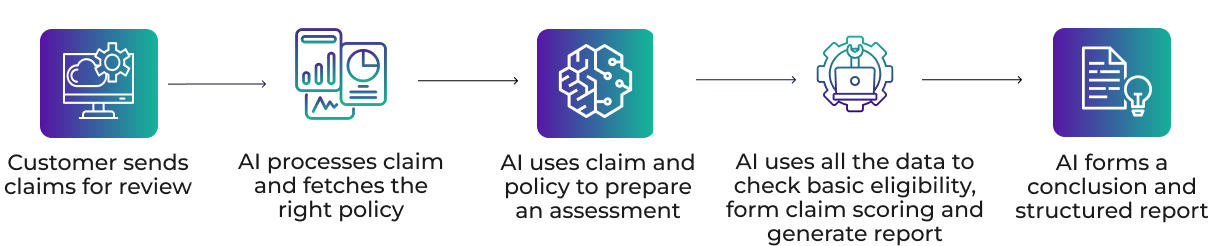
Dedicatted designed the solution to integrate directly into Xodus‘s internal claims adjudication flow, ensuring minimal disruption to existing operations while enhancing efficiency and scalability.
- Seamless CRM Integration – The AI-powered adjudication system is fully embedded within Xodus’s internal CRM, enabling adjudicators to review AI-processed claims without switching platforms.
- Dynamic Policy & Vendor Management – Automated pipelines allow real-time addition and versioning of insurance policies and vendor data, ensuring adaptability to evolving business needs.
- Configurable AI Rules & Thresholds – Business users can fine-tune confidence thresholds and adjudication rules without requiring manual code changes.
- Scalable & Modular Architecture – Built on AWS cloud-native services (Amazon Bedrock, Amazon OpenSearch Service, Amazon ECS on AWS Fargate, Amazon QuickSight), the solution scales with growing transaction volumes.
Technology & Approach
To transform claims processing, we implemented a modular Generative AI-powered automation system, implementing separate AI flows for each key process step. The stack runs on Amazon Bedrock for the generative AI flows, Amazon OpenSearch Service for policy and claim retrieval, Amazon ECS on AWS Fargate for the processing services, and Amazon QuickSight for adjudication analytics. This approach ensures high accuracy, scalability, and seamless integration with existing infrastructure.

Key Components
- Policy Preprocessing & Claim Validation
AI-driven validation ensures claims align with individual policy terms by extracting key conditions and coverage details. - Claim Preprocessing
Structured data extraction and classification streamline claims before adjudication, reducing manual effort. - Intelligent Document Processing (IDP)
Extract relevant details from medical reports, invoices, and other claim-supporting documents. - AI-Powered Claim Confidence Scoring
A rules-based AI engine evaluates claim eligibility and documentation compliance, assigning confidence scores based on extracted data. - Automated Workflows & Decisions
Platform orchestrates claim assessments, automating repetitive tasks while integrating human validation where needed.
Architecture on AWS
- Deployed entirely in the AWS Canada (Central) Region, ca-central-1, so all claim and policyholder data stays in Canada.
- Claims arrive through a REST API on Amazon API Gateway, protected by AWS WAF with managed rule groups. The TLS certificate is issued and rotated by AWS Certificate Manager.
- The adjudication workflow runs on Amazon ECS on AWS Fargate in private subnets across three Availability Zones, reached through an API Gateway VPC Link, with one NAT Gateway per zone.
- Three Amazon Bedrock agents do the work: one extracts the facts of the claim from the submitted documents, one aligns those facts to the governing policy clauses, and one scores the decision and surfaces the evidence behind it.
- Amazon OpenSearch Service holds the policy rules and their embeddings, so every decision points back to the specific clause it relied on.
- Claim and policy documents are stored in Amazon S3. Amazon QuickSight reports on throughput, accuracy and confidence distribution.
- Operator access is through AWS Systems Manager Session Manager: no bastion hosts, no long-lived keys. Monitoring runs through Amazon CloudWatch.
- Every decision carries a confidence score and a reference to the policy clause it relied on, so an adjudicator can accept, question or override it.
- Decisions are written back into the CRM the adjudication team already uses.
Results & Business Impact
The GenAI-powered solution transformed claims processing, turning it from a bottleneck into a competitive advantage. By automating routine assessments, claims adjudicators can now focus on complex cases that require more attention while customers benefit from faster and more consistent claim resolutions.
Key Outcomes
- Manual document processing effort reduced by approximately 70%, measured by time sampling across a representative set of claims before and after.
- Adjudicator throughput up 85%: from 4.0 to 7.4 completed adjudications per adjudicator per working day, reported from the QuickSight operational dashboard, same month before and after go-live to hold the seasonal profile constant.
- Policy interpretation standardised, reducing variation between adjudicators on materially similar claims.
- Confidence scoring on every decision gives adjudicators a basis to accept, question or override.
- All claim and policyholder data resident in Canada.
- Xodus contracted and launched a second, larger phase two months after the first went live.
Business Impact
- Scalable framework that adapts to increasing transaction volumes.
- Continuous learning enhances claim assessment accuracy over time.
- A standardized evaluation process ensures compliance and reduces risk.
- Advanced data analytics unlocks new insights for process optimization.
Related service. Cloud software development services at Dedicatted.