Read summarized version with
The way that organizations collect, store, and analyze data has evolved over the years. From databases, to data warehouses, to data lakes, this evolution has gone hand-in-hand with other innovations: like the internet, big data analytics, and now AI. To help understand where we are today, let’s take a look back at how far data lakes have come.
It all started with big data. In the early days of big data, traditional data warehouses struggled to keep up with the growing volume and variety of information being produced. Designed for structured data, they left unstructured and semi-structured data largely untapped. Data lakes, which emerged in the early 2010s, set out to close the gap. A data lake is a vast repository that stores raw data in its native format, regardless of its structure or intended use,giving organizations new opportunities to collect and analyze all types of data.
Data lake migration has moved to a prerequisite for any organization serious about AI. That’s the view our experts at Dedicatted keep arriving at with clients: the infrastructure decisions made years ago are now the biggest blocker to getting the most out of AI investments. Here’s our take on why that is, where the economics actually land, and how we advise clients to run the migration itself.
Legacy data lakes came with challenges
While offering control and security, on-premises data lakes made it hard for organizations to get the most from their data assets. Challenges included:
- Scalability limitations. Constrained by the physical capacity of hardware infrastructure, it was costly and time-consuming to scale up to accommodate growing data volumes and processing demands. This led to performance bottlenecks and hindered the ability to handle spikes in data or workloads.
- High Upfront and Maintenance costs. Building and maintaining an on-premises data lake involved substantial upfront investment in hardware, software licenses, and IT infrastructure. Ongoing maintenance, including hardware upgrades, software updates, and security patching, added to the total cost of ownership.
- Management Overheads. Specialized expertise and dedicated IT resources were needed for tasks like hardware provisioning, software installation, configuration, performance tuning, and security management. This took time away from higher-value activities like data analysis and insight generation.
- Limited access to innovation. The latest advances in analytics, AI, and cloud-native services: such as serverless computing, AI/ML platforms, and advanced analytics tools were not compatible with on-premises data lakes. This impeded innovation and made it hard to drive business advantage from data.
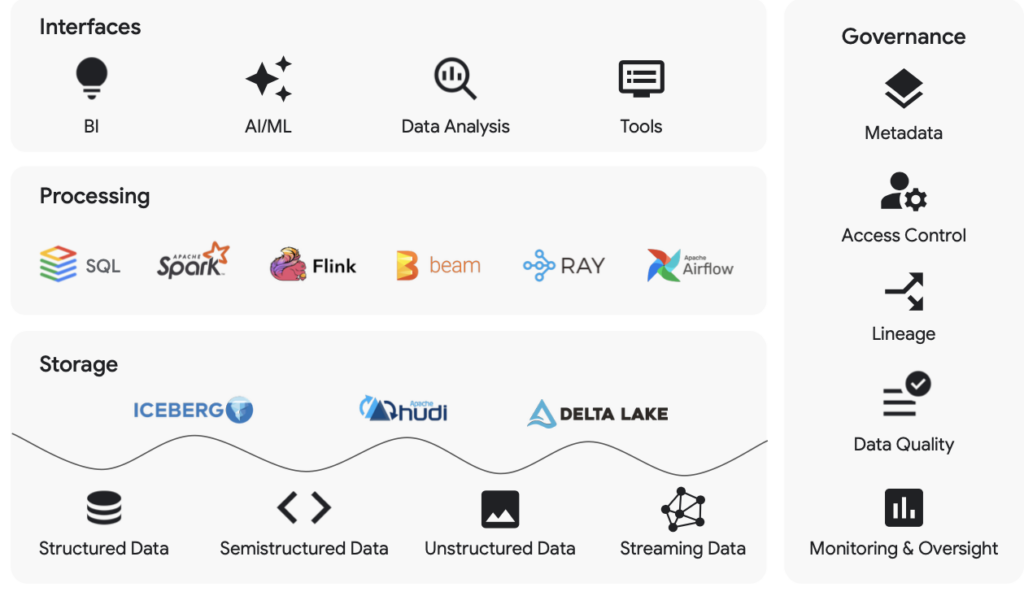
We advise clients to think of a modern cloud data lake as four layers working together: storage (structured, semi-structured, and unstructured data, increasingly in formats like Apache Iceberg, which adds transactional guarantees, schema evolution, and time travel that legacy Hive tables never offered), processing (elastic engines like Spark, Flink, or Ray that spin up only when needed), tools and interfaces (BI tools, notebooks, SQL workbenches, APIs), and governance (metadata management, access control, lineage, and quality checks).
Our view is that this structure is what actually closes the gap between having data and using it and it’s the direct reason cloud migration has become an AI-readiness project as much as an infrastructure one. Legacy lakes simply can’t handle the volume of unstructured data AI workloads demand, and data silos across warehouses, lakes, and clouds only compound the problem. The results we point clients to speak for themselves: one of our clients – a Canadian insurer migrated a legacy on-premises platform to BigQuery in just 10 months, cutting annual infrastructure and operations costs by more than 30% while improving infrastructure setup speed by 10x.
The economics of Data Lake Migration, in our experts’ opinion
Cost is almost always the trigger for a migration conversation, and it should be. On-premises data lakes carry heavy capital and operational expenditure, require costly hardware additions as data grows, and demand expensive specialized staff to keep running. But our experts are just as focused on the opportunity cost side of the ledger: the inflexibility of on-premises systems slows innovation and AI adoption, and that’s a cost that compounds every quarter an organization waits.
The cloud replaces that model with pay-as-you-go pricing tied to actual usage, and we recommend clients map their total cost of ownership across six components: storage (priced per gigabyte and shaped by access tier), compute (charged by instance type and duration for ETL, querying, and ML), managed services, data transfer, orchestration and management, and governance (security/compliance). Independent research backs up what we see in practice: organizations using a managed cloud data lake instead of a self-managed or on-premises one typically see 20–62% lower costs, and moving to a lakehouse architecture that unifies data lakes and warehouses on a managed service can cut costs by 80–90%.
We’ve watched this play out with real companies. One of our clients saw BigQuery storage deliver cost reductions of up to 18%, plus reduced downtime and faster app deployment. Another, migrating from Hadoop to Dataproc, achieved around 30% cost savings in certain clusters by tuning the balance of on-demand and spot VMs, with one application ending up over 10x faster.
That said, we’re always upfront with clients that migration isn’t free, and we build the following into every cost model: cloud infrastructure that has to run in parallel with the legacy system until cutover, professional services (consulting, implementation, training), data transfer and egress fees, data transformation and cleansing work, and new licensing costs. Post-migration, our recommendation is a continuous optimization discipline: right-sizing compute and storage, autoscaling, choosing the correct storage tier, using reserved or spot instances where workloads allow it, compressing data and applying lifecycle policies, and monitoring spend on an ongoing basis rather than treating cost control as a one-time exercise
Migration risks that must be carefully managed
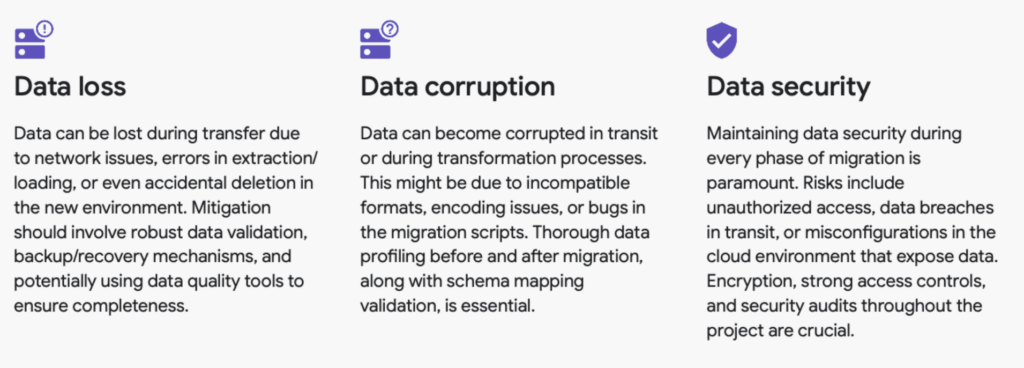
When migrating a data lake to the cloud, there are three broad areas that can pose a risk to your organization. Here’s what to watch out for and how to mitigate the risks
Project Management and Execution Risks. Unrealistic timelines: Underestimating the complexity and time required for migration can lead to rushed decisions, increased errors, and ultimately project failure. Thorough planning, including realistic timelines with buffers.
Skill Gaps: A lack of cloud expertise, including skills in cloud platforms, data migration tools, and security best practices can significantly hamper the project. Training existing staff or bringing in experienced cloud professionals is often necessary for unexpected issues, is key.
Poor communication: Migration projects involve various stakeholders. Poor communication can lead to misunderstandings, missed deadlines, and conflicts. Establish clear communication channels and ensure all stakeholders are informed and aligned.
Insufficient Testing. Testing is crucial to identify and address potential issues before they impact production. If it’s rushed or inadequate, costly post-migration problems can arise. Comprehensive testing strategies, including performance and security testing, are a must.
Planning and Executing a Successful Data Lake Migration
Our experts structure every engagement around five phases, and we won’t move past the first one until an organization has secured C-level sponsorship and assembled a genuinely cross-functional team spanning IT, data engineering, data science, BI, and the business units that actually consume the data. Communication channels and a plan for upskilling need to exist before a single workload moves.
Phase 1: Discovery. We build a full inventory of the current environment: data assets (sources, types, volumes, downstream consumers, metadata), workloads (ETL pipelines, queries, ML models, and their dependencies), governance (classification, retention, access rules, compliance), and workflows (DAGs, schedules, resource requirements) and we map business SLAs alongside the technical detail, since those SLAs are what should actually drive migration priority.
Phase 2: Assessment. This is where we help clients pick a strategy, and our advice differs by situation: lift-and-shift (move as-is, fastest, but leaves cloud benefits on the table), lift-and-optimize (migrate first, then incrementally adopt managed services – usually our default recommendation for balancing speed and payoff), or full modernization (re-architect for cloud-native capabilities from day oneL higher upfront cost and timeline, but the strongest long-term return). We also design the target architecture across six elements: storage, compute, networking, security, governance and metadata unification, and migration tooling.
Phase 3: Planning. We insist on a living project plan: timelines and milestones phased by business criticality, task breakdowns and dependencies, clearly assigned roles and responsibilities, a real budget, and a documented rollback plan, because in our opinion a migration plan without a rollback plan isn’t actually a plan.
Phase 4: Execution. Data, metadata, governance, workflows, and workloads move in this phase, and we treat data integrity verification, checksums, schema validation, reconciliation, as non-negotiable before, during, and after transfer. Metadata migration has to preserve lineage. Governance policies need to be enforced consistently via IAM throughout, not bolted on afterward. We typically recommend refactoring workflows onto cloud-native orchestration (Cloud Composer, for example) and workloads onto serverless compute rather than a pure lift-and-shift, because that’s where most of the long-term value gets left on the table if skipped.
Phase 5: Optimization. We tell every client that migration doesn’t end at cutover: ongoing performance tuning, continuous cost optimization, stronger governance tooling, and adoption of new cloud-native features as they ship are what compound the value of the move over the following years.
How Dedicatted approaches data lake migration
When implemented correctly, Data Lakes accelerate how organizations can use data to drive results. Dedicatted optimizes and automates the configuration, processing, and loading of data into an AWS Data Lake. Our approach eliminates time-consuming setup and management efforts while ensuring you can quickly integrate with sophisticated BI tools like Tableau, Power BI, AWS Quicksight, and other modern analytics platforms.
We bring our clients hands-on migration expertise, architecture reviews, and the kind of pattern-matching that only comes from running this process repeatedly across industries, helping teams avoid the timeline and cost overruns that undermine so many migrations, and making sure the AI capabilities the business actually wants are reachable on the other side of the move, not just theoretically available.
As an AWS Premier Tier Services Partner and top 2% global AWS partner with GenAI Competency and MSP designation, we combine deep cloud expertise with hands-on engineering and help organizations develop robust Data Lakes and comprehensive data and analytics strategies that drive results. Our teams have the experience, AWS data, and analytics knowledge, plus our own research initiatives, to help you plan and execute your data-driven strategy. If your organization is weighing a data lake migration, our recommendation is simple: start with discovery before you start comparing vendors. Get in touch with our team at Dedicatted to talk through where your environment stands today.
Related service. Data migration consulting at Dedicatted.