Read summarized version with
About project
Working time:
2025-ongoing
Industry:
Media and Entertainment
The service:
AI/GenAI solution development on AWS
Overview
A global television network broadcasting in more than 150 countries and reaching over 450 million viewers needed to transform how it manages and discovers video content across production systems and archival libraries.
With continuously expanding media volumes and increasing demand for faster production workflows, the organization required a scalable solution capable of understanding video context, improving content discoverability, and enabling teams to retrieve relevant footage using natural language.
The objective was not only to improve search accuracy, but to create an intelligent foundation for content reuse, operational efficiency, and long-term monetization of media assets.
The Challenge
Our client managed extensive video libraries across production systems, archives, and internal repositories. While the content held significant editorial and commercial value, it was difficult to access in practice. Traditional metadata and keyword-based search methods could not capture the full meaning of video content. They relied on manual annotations and static tags, which were often incomplete, inconsistent, or outdated. As a result:
- Slow and inefficient content discovery across archives and production libraries
- Heavy reliance on manual workflows and inconsistent metadata
- Limited ability to reuse and monetize existing content
- Lost productivity for editors, producers, and content teams searching for relevant footage
- Lack of a scalable approach to support future content growth
The organization needed a platform that could automatically interpret video content, enrich it with contextual understanding, and make it searchable through natural language, while integrating with existing production environments.
Want to get your copy of case study?
By submitting this form, you agree with our Terms & Conditions and Privacy Policy.
Technology & Approach
Dedicatted designed and implemented a GenAI-powered video intelligence platform that combines automated ingestion, AI-driven analysis, semantic indexing, and conversational search within a unified cloud-native architecture. The solution was built to treat video not as static files, but as structured, searchable data.
Scalable ingestion and processing pipeline
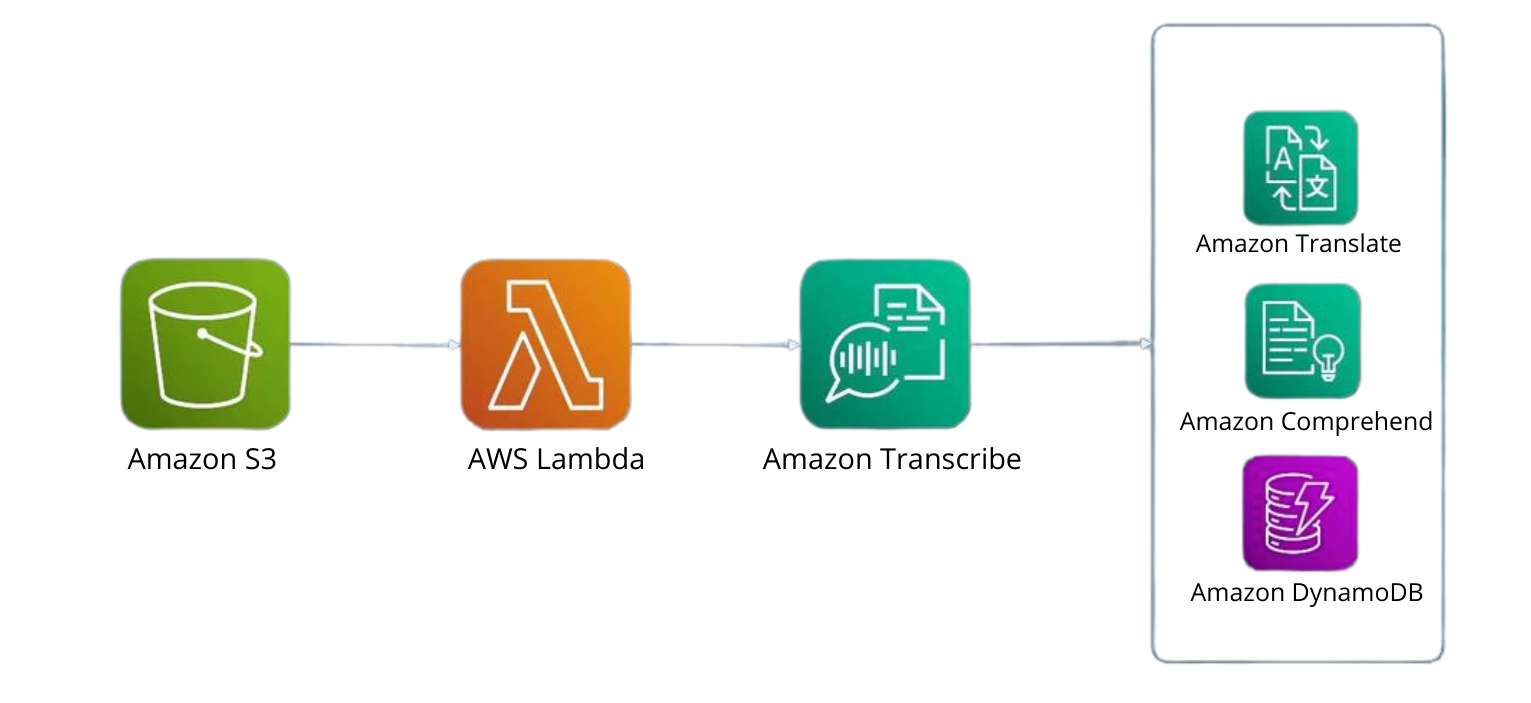
Video assets from production and archives were stored and managed in AWS S3, providing durable, scalable storage as the foundation for processing workflows.
Event-driven processing pipelines powered by AWS Lambda enabled automated ingestion and analysis of new and existing video content. This allowed the platform to process media continuously without manual intervention.
Videos were segmented into meaningful units using time-based, scene-based, and camera-based segmentation strategies. Breaking long-form footage into structured segments enabled more accurate indexing and retrieval.

Semantic enrichment and vector indexing
Generated captions, transcripts, and existing metadata were combined and enriched into a unified content representation. This information was converted into vector embeddings, enabling semantic understanding of content rather than keyword matching. Embeddings were indexed within a semantic search index powered by OpenSearch / vector database, allowing the system to identify relationships between scenes, themes, and concepts across the entire media library.
This approach enabled users to search based on intent and meaning, even when exact keywords were not present in metadata
Natural-language search and API-driven access
A semantic search layer was exposed through API Gateway, enabling applications and internal tools to query the video library using natural language. Editors, producers, and researchers could describe scenes, topics, or actions conversationally, and retrieve relevant video segments ranked by contextual relevance. This significantly improved the usability of archives and integrated discovery into existing production workflows.
Cloud-native orchestration and microservices architecture
The entire platform operated within a cloud-native microservices architecture, supported by AI orchestration pipelines managing ingestion, analysis, indexing, and retrieval workflows. This architecture ensured: scalability for growing video volumes, reliable processing performance and modular expansion for future GenAI capabilities. It was designed to operate at enterprise scale while maintaining flexibility
GenAI-powered content understanding
AI models orchestrated through Amazon Bedrock were applied to interpret video content and generate structured descriptions. These models produced captions and contextual summaries describing:
- Scene-level context
- Subjects and participants
- Objects and environments
- Actions and events
A core design principle of the platform is cost-aware GenAI usage. By applying GenAI only after deterministic validation steps, the system minimizes unnecessary inference calls and prevents low-confidence data from entering business systems.
Amazon Transcribe was used to convert speech into text, adding an additional layer of searchable content through subtitles and dialogue analysis. This process transformed raw video into machine-readable knowledge, significantly reducing reliance on manual tagging.
Business impact
The GenAI-powered video intelligence platform delivered measurable improvements across content discovery, archive utilization, and operational efficiency:
- Faster content discovery: Teams locate relevant footage across production libraries and archives significantly faster using semantic search.
- Reduced retrieval time: Editors and producers spend less time navigating fragmented systems and manual metadata, accelerating production workflows.
- Improved archive utilization: Previously underused footage became more accessible, increasing opportunities for content reuse and repurposing.
- Operational efficiency at scale: Automated ingestion, transcription, captioning, and indexing reduced manual workloads while supporting continuous content growth.
Long-Term Value
- Foundation for intelligent media operations: Semantic understanding and natural-language search enable long-term transformation of how the network manages and leverages its content ecosystem.
- Enhanced monetization potential: Improved discoverability allows the network to identify valuable assets for licensing, redistribution, and new content creation.
- Scalable AI-driven workflows: The platform supports future content growth and can integrate additional AI capabilities over time.
- Enterprise-grade reliability: Production-ready deployment ensures performance, scalability, and seamless integration with existing systems.
This initiative marked a shift from treating video as static media to managing it as a dynamic, intelligent asset. Content teams can now navigate vast libraries with clarity and speed, uncovering relevant footage in ways that were previously impractical or impossible. What used to depend on manual effort and institutional knowledge is now supported by a system that understands context, intent, and relationships across content.
Beyond improving day-to-day operations, the platform introduces a new way of thinking about media value. Archives become a strategic resource rather than a storage challenge, and discovery evolves from a technical task into a creative and commercial enabler. With a scalable AI foundation in place, the organization is positioned to continuously expand how it produces, reuses, distributes, and monetizes content – while adapting to the next generation of media workflows.