Read summarized version with
For most of the last decade, “scaling CI/CD” meant adding tools: another linter, another scanner, another dashboard. In 2026, that approach has run out of road. Across the engagements and data we track at Dedicatted, one pattern keeps repeating: organizations are short on coherence between the tools they already have.
Our analysis of how engineering organizations structure platform and DevOps work shows that developer friction is no longer concentrated in one obvious bottleneck. Limited visibility into systems, difficulty finding standards or “golden paths,” high cognitive load, manual processes, and slow feedback loops all sit within a few points of each other, in the 40–41% range. That even spread is the tell: the problem isn’t a missing tool. It’s a system that has grown too distributed for any single team to hold in their head.
Data from IT, development, operations, and platform engineering professionals backs this up from a different angle. CI/CD pipelines are now table stakes, but their maturity varies wildly. Only 27% of organizations validate code daily; 51% still test on a weekly cadence, which is plenty of time for undetected issues to compound before they surface, usually after release. Meanwhile, 84% have already adopted code scanning tools and 85% are using AI for real-time issue detection, so the raw capability is there. What’s missing is a pattern for putting it all together.
At Dedicatted, this is the conversation we have with almost every engineering leader we talk to right now: not “which tool should we add,” but “why does adding tools keep making things feel more complicated, not less.” Below are the patterns we’re seeing actually move the needle for teams trying to scale CI/CD in 2026 and the ones that look good in a slide deck but don’t survive contact with a real engineering org.
Pattern 1: Pick one path forward, not a menu of options
The instinct when a pipeline breaks or a new team onboards is to give them options: pick your build tool, pick your test runner, pick your deployment target. In practice, this is exactly what has made toolchains unmanageable. Every team ends up maintaining a slightly different stack, and every reorg or hire means relearning tools that, underneath, don’t do anything meaningfully different from the ones they replace.
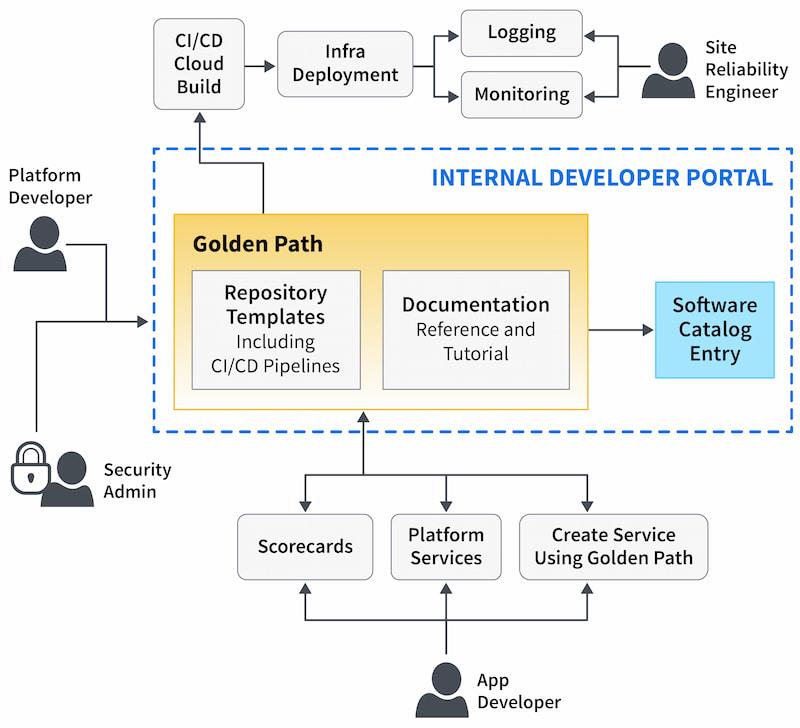
The pattern that scales instead is the “golden path”: one well-supported, opinionated, largely automated route from commit to production that covers the 80% of cases that don’t need anything exotic. Teams that deviate from it can still do so, but they own that complexity themselves rather than pulling the whole organization into supporting it. This is precisely the argument platform engineering has been built on: reduce the number of decisions a developer has to make before they can ship anything, and let a platform team’s expertise be encoded into the paved road rather than re-explained in every onboarding ticket.
At Dedicatted, this is how we approach CI/CD automation engagements. We start by understanding your business drivers and current tech stack, then design a streamlined pipeline that covers your standard deployments without locking out the exceptions. The result is self-healing CI/CD that accelerates time-to-market while eliminating the cognitive overhead of constant tool switching.
Pattern 2: Policy and security as pipeline logic, not a pre-deploy checklist
Security and compliance rank as the single largest priority for platform and DevOps investment we’re seeing across the market (45%), narrowly ahead of deployment reliability (43%) and developer productivity (42%). More tellingly, 52% of teams say security scanning and policy automation is the toolchain area they most want integrated into a unified platform: the highest of any category, ahead of even CI/CD workflows themselves (42%).
That reordering matters. Security is no longer a gate bolted onto the end of a pipeline; it’s becoming pipeline logic: policy-as-code that runs automatically at every stage, the same way a build step or a test suite does. Teams that treat scanning as a separate, late-stage checklist are the ones still fighting fires after release. Teams that write policy directly into the pipeline definition are the ones reporting the benefit organizations most associate with mature platform engineering: stronger security enforcement, cited by 51% of respondents as the top payoff of doing this well.
DevSecOps is where this shows up in practice. Embedding SCA (software composition analysis), SAST (static application security testing), secrets scanning, and policy-as-code directly into your CI/CD workflow means vulnerabilities and misconfigurations are caught at commit time, not in production.
Dedicatted’s approach to DevSecOps embeds these controls into your pipeline without slowing releases, shifting security left without creating bottlenecks.
Pattern 3: Continuous validation, not batch testing
The gap between the 27% of organizations testing daily and the 51% testing weekly is one of the more actionable numbers we track. Weekly validation isn’t a minor cadence difference – it’s a structurally different risk profile. Issues introduced early in the week sit undetected for days, and by the time they surface, they’re tangled up with every other change that landed in the meantime, making root cause analysis slower and rollbacks messier.
Shifting from weekly to daily (or per-commit) validation is less about buying a new testing tool and more about pipeline design: parallelized test suites, environment provisioning that doesn’t bottleneck on a shared staging server, and feedback loops short enough that developers actually wait for the result instead of context-switching away and losing the thread. This is also where slow feedback loops show up as a top complaint (cited by 40% of respondents, and 52% among the most experienced practitioners) – the more experienced the engineer, the more feedback speed dominates their list of frustrations.
Infrastructure as Code plays a critical role here. When your test and staging environments are defined as code (Terraform, CloudFormation) rather than hand-provisioned, you can spin up parallel test environments on-demand, eliminate wait times, and ensure every environment matches production.
Dedicatted uses IaC and GitOps to make environment provisioning part of the pipeline itself, turning a manual bottleneck into an automated, repeatable step.
Pattern 4: AI in the pipeline, with a human still holding the wheel
AI-assisted automation is now the single largest investment priority for platform and DevOps teams looking ahead (46%), ahead of predictive incident response (41%) and pipeline optimization (40%). On the observability side, 85% of organizations are already using AI-powered tools for real-time issue detection.
The pattern that scales isn’t “hand the pipeline to AI.” It’s AI doing the narrow, well-bounded jobs: flagging anomalies, suggesting flaky-test culprits, predicting which change is likely to break a downstream service, while humans keep control over what actually merges and deploys. The data shows why this distinction matters: 70% of engineers with under a year of experience want more AI-driven automation, while the most experienced practitioners are notably more cautious, particularly about validation and control. That caution isn’t resistance to change; it’s earned knowledge that systems relying heavily on automated decisions get harder to reason about exactly when something goes wrong. Pipelines that scale build in the audit trail and the override, not just the automation.
Dedicatted’s approach to AI-driven DevOps applies GenAI for root-cause analysis, predictive alerts, and intelligent runbooks: cutting MTTR and release risk through data-backed decisions, not blind automation. When you embed AI into observability and incident response, you amplify your team’s ability to respond faster without surrendering visibility or control.
Pattern 5: Cost and compliance as pipeline outputs, not quarterly audits
Among more tenured practitioners, cost governance and compliance both jump to 56% as infrastructure priorities: well above where less experienced teams rank them. That’s a signal that as organizations scale, the CI/CD pipeline itself becomes the natural place to answer questions that used to live in a spreadsheet after the fact: what did this environment cost, who approved this change, does this deployment meet the policy baseline. Building that instrumentation into the pipeline, rather than reconstructing it after an audit request, is one of the clearer maturity signals we look for when we assess a client’s DevOps setup.
Cost optimization and observability go hand-in-hand. When you instrument your pipeline to track infrastructure spend in real time and correlate it with deployment activity, you can optimize cloud usage before bills surprise you. Dedicatted’s cost optimization and observability-SRE services build that visibility into your CI/CD workflow and production systems, so compliance and cost governance aren’t overhead – they’re built-in outcomes of how you deploy.
Pattern 6: Measure before you scale
It’s tempting to treat “scale” as a tooling problem you can solve by buying more automation. The teams that actually get there first get honest about where they stand. A proper DevOps strategy engagement starts with an assessment: mapping culture, technical practices, infrastructure, and security against a defined maturity baseline, before committing to a roadmap. Skipping that step is how organizations end up investing in AI-assisted automation or a shiny new orchestrator while the underlying friction: unclear ownership, inconsistent environments, no golden path stays exactly where it was.
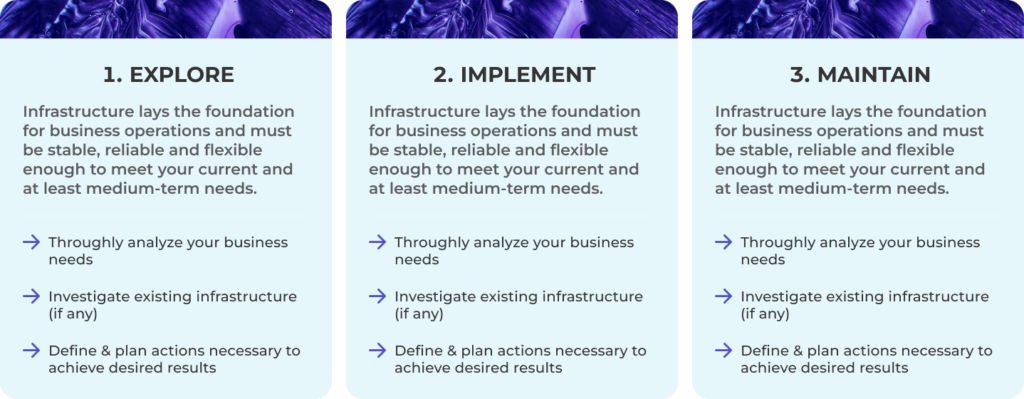
This is Dedicatted’s “Explore” phase: a deep dive into your business drivers, tech stack, and current state, resulting in a clear roadmap of what to build, in what order, and why it matters to your business. From there, we move to “Implement” – building the actual CI/CD, containerization, and infrastructure-as-code to support your golden path and then “Maintain” to ensure the platform evolves with your needs.
Where these patterns come to life: Real scenarios
Scenario 1: The high-growth SaaS team – Speed vs. consistency
A fast-growing fintech startup was shipping features but losing speed to deployment delays and environment inconsistencies. Every team had built their own CI/CD workflow; staging deployments took 3+ hours and frequently failed in unpredictable ways. Problem: they’d optimized for feature velocity without optimizing for deployment velocity.
Dedicatted conducted a DevOps strategy assessment and discovered the real bottleneck was environment provisioning. We implemented a unified golden path using Infrastructure as Code (Terraform) and a self-service portal for developers to spin up ephemeral test environments. Every commit now spins up a parallel test environment automatically. Result: deployment time dropped to 15 minutes, environment parity became automatic, and the team shipped on a daily cadence without engineering as the gating function.
Scenario 2: The compliance-heavy enterprise – Speed vs. security
A healthcare organization had layered security checks onto their pipeline as audit requirements, but the checklist became so burdensome that teams were finding workarounds. Problem: compliance had become the enemy of delivery.
Dedicatted re-architected their CI/CD with DevSecOps controls baked directly in: SCA, SAST, secrets scanning, and policy-as-code ran on every commit, with intelligent exception handling and transparent approval workflows. Security didn’t slow releases; it became a routine part of the pipeline. Compliance audits went from weeks of manual evidence gathering to an automated report pulled from pipeline logs. They doubled release frequency while improving their audit score.
Scenario 3: The multi-cloud transition – Lock-in vs. flexibility
A retailer was negotiating with AWS but realized their deployment scripts were AWS-specific, eliminating negotiating leverage. Problem: Infrastructure was tightly coupled to a single cloud vendor, making cost optimization and flexibility impossible.
Dedicatted designed a cloud-native, platform-agnostic architecture using Kubernetes for orchestration and IaC (Terraform) for infrastructure abstraction. The same Helm charts and Terraform modules now deploy identically across AWS, Azure, and GCP. Result: They could run RFPs across all three clouds, secure better pricing, and had a true multi-cloud strategy. What would have been a six-month cloud migration became a strategic advantage.
Scenario 4: The observability blindspot – Deploying vs. debugging
An operations team had containerized microservices and moved to Kubernetes, but they still couldn’t see inside the system. When incidents happened, MTTR was 2+ hours because debugging required manual context-switching between scattered logs, metrics, and traces that weren’t connected. Problem: they had cloud-native infrastructure but pre-cloud-native visibility.
Dedicatted built out observability and SRE practices: unified logging with structured context, distributed tracing that follows requests end-to-end, and AI-assisted alerting that surfaced likely root causes before the customer noticed. Incidents that used to take 2 hours to resolve now took 10 minutes, even for engineers new to the service. They also reduced alert fatigue dramatically by cutting noise with AI-driven anomaly detection.
Scenario 5: The containerization sprawl – Moving fast vs. staying safe
A payments processor had containerized their monolith and moved to Kubernetes, but deployment consistency suffered. Some teams used custom Docker images, others used container registries inconsistently, and there was no standard for how to handle secrets, config, or rolling updates. Problem: containers promised portability and consistency but delivered neither.
Dedicatted established platform engineering practices with a golden path for containerization and orchestration. We built a developer portal that abstracts Kubernetes complexity:developers define their app’s resource needs and environment variables, and the platform handles the rest: container builds, registry management, secrets injection, and rolling deployments. It looked like infrastructure magic; it was actually just opinionated defaults. Release velocity increased, operational incidents from configuration drift dropped 80%, and the platform became self-service.
Scenario 6: The healthcare provider – Compliance vs. speed (the false choice).
A fast-growing digital healthcare company needed to migrate from AWS to Azure, serve thousands of active users without downtime, maintain HIPAA compliance, and somehow ship features faster. The trap most regulated orgs fall into: you get security or speed, pick one. They thought it was impossible until they realized security and speed aren’t enemies – they just need to be architected together.
We migrated them to Azure with Infrastructure as Code, built GitOps-driven ephemeral environments (every development branch spun up its own isolated, fully compliant environment automatically), and embedded DevSecOps controls directly into the pipeline (SCA, SAST, secrets scanning, policy-as-code on every commit). The result: zero downtime migration, HIPAA controls built-in not bolted-on, deployment time dropped, and compliance audits went from weeks of manual evidence gathering to an automated report pulled from pipeline logs. They doubled release frequency while strengthening their security posture. That’s what happens when you stop treating compliance as overhead and start treating it as pipeline design. Read more
How Dedicatted Approaches CI/CD in 2026
Modern software delivery is built on coherent systems where competing demands (speed, security, reliability, cost) are reconciled through architecture, not traded off team by team. The organizations scaling in 2026 aren’t the ones with the most tools – they’re the ones making their existing systems work together. But building coherent systems requires more than consultant recommendations. It requires hands-on engineering, architecture that survives reality, and deep expertise in cloud platforms and DevOps practices. That’s where Dedicatted comes in.
We’re cloud engineers who’ve built scalable DevOps infrastructure for fintech startups, healthcare providers, retailers, and payments processors. We migrate complex systems without downtime. We embed security into pipelines so compliance becomes a side effect of how code ships. Our approach starts with honest assessment: we audit your business drivers, map your current state, identify real gaps. Then we build: CI/CD automation, Infrastructure as Code, Kubernetes, DevSecOps, observability, cloud-native architecture, cost optimization. All grounded in patterns that actually scale.
As an AWS Premier Tier Services Partner and top 2% global AWS partner with GenAI Competency and MSP designation, we combine deep cloud expertise with hands-on engineering. But credentials matter less than track record: we’ve doubled release frequency while improving security scores, turned cloud migrations into strategic advantages, and built platforms that make the hard way to ship code become the easy way. Here’s the question: where’s your friction? Scattered visibility? Unclear standards? Manual slowdowns? High cognitive load? Or deeper: a lack of coherence across your entire delivery system? We start by getting honest about that, then build the solution that fits your business. Let’s talk about your friction and what scaling actually looks like for you.