Read summarized version with
If you run drug discovery at a biopharma organization, you’re managing a portfolio under three converging pressures: patent cliffs compressing your timeline to revenue, R&D productivity that has been flat or declining for over a decade despite rising budgets, and a board asking increasingly pointed questions about what your AI strategy actually is: not whether you have “an AI pilot,” but whether it’s changing your cost per approved molecule.
Our numbers explain the urgency: the average therapy still costs somewhere between $1 billion and $2.6 billion to bring to market, takes 10–15 years, and fails roughly 90% of the time between discovery and approval. Canada’s Centre for Health Solutions estimates a top-10 biopharma company with $65–75 billion in revenue could unlock $5–7 billion in value over five years by scaling AI and that R&D is the single largest opportunity area in that value chain, representing 30–45% of the total.
It’s a live operating question for anyone running a discovery portfolio: which parts of your workflow should move to AI-native methods first, what infrastructure does that require, and how do you validate that the molecules coming out the other end are real candidates rather than computational artifacts.
AI-Accelerated Molecule Design, defined: the Technical Foundations
It’s worth being precise about the mechanism, because the term gets used loosely. There are two distinct capabilities in play, and most production platforms combine both.
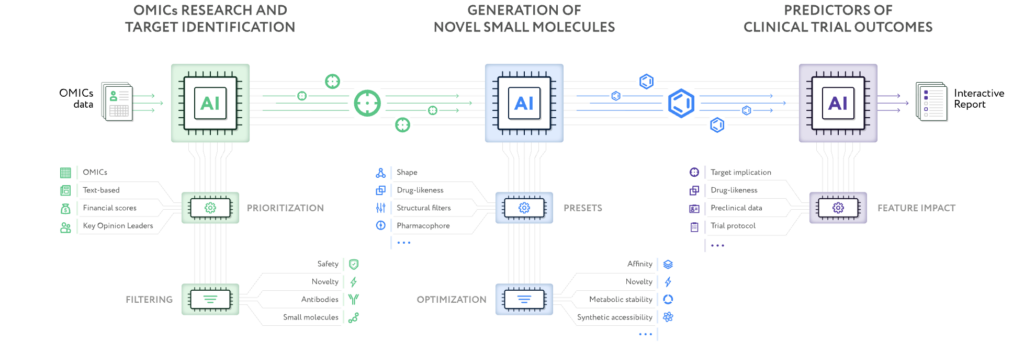
Target discovery and validation uses machine learning: often multi-omics models trained on genomics, proteomics, and clinical data to identify disease-associated proteins that could be modulated therapeutically, and to prioritize which of those targets are both biologically credible and druggable. This is where platforms like we could create operate: mining omics data, scientific literature, patents, and grant databases with NLP to score novel targets before a chemist ever touches a molecule.
Generative molecular design is the newer and more technically interesting layer. Rather than screening existing compound libraries – the traditional virtual-screening approach, which ranks millions of known molecules by predicted binding affinity, generative models create new molecular structures from scratch, conditioned on the 3D geometry and chemical environment of a specific protein binding pocket. A recent technical review maps the major architectural families your team will encounter:
- Autoregressive / graph neural network models build molecules atom-by-atom or fragment-by-fragment, making sequential placement decisions conditioned on the binding pocket (e.g., Pocket2Mol, GraphBP). Transformer-based variants like Lingo3DMol apply the same attention mechanism used in language models to generate molecules fragment-by-fragment, the way an LLM generates a sentence word-by-word.
- Diffusion models (TargetDiff, DiffSBDD, PMDM) learn to transform random noise into chemically coherent structures through iterative denoising — the same underlying technique behind image-generation models, applied to 3D molecular coordinates and atom types.
- Variational autoencoders (VAEs) compress molecular structures into a continuous “latent space” and decode new molecules by sampling from regions likely to bind a given target, useful for exploring cryptic or allosteric binding sites that pocket-dependent methods can miss.
- Genetic algorithms and reinforcement learning treat molecule generation as an optimization problem: mutating and selecting compounds generation-over-generation (AutoGrow4, JANUS), or training an RL agent rewarded for hitting desired binding, ADMET, and synthesizability targets (SMILES-RNN, LibINVENT).
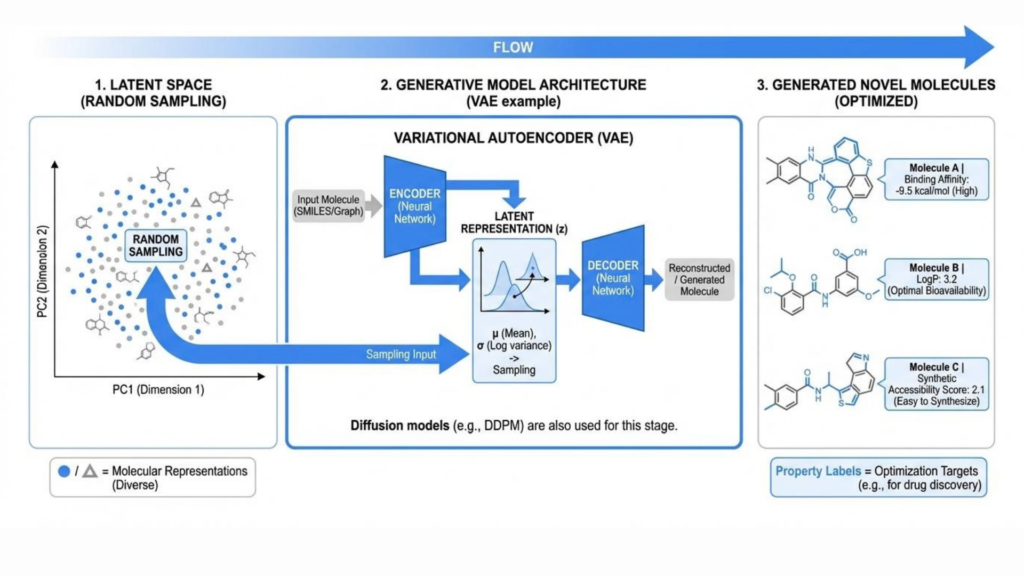
The same toolkit extends into lead optimization: taking a validated hit and refining it for the ADMET profile, safety margin, and manufacturability a real drug candidate needs, via fragment addition, scaffold hopping, and fragment-linking methods.
Why this matters: these methods let your team explore chemical space that virtual screening simply can’t reach, because you’re not limited to compounds that already exist in a library. That’s the mechanism behind claims like “undruggable target” programs becoming tractable – recent forecast explicitly names de-novo protein design and in-silico methods as drivers of improved speed and accuracy in identifying viable candidates for targets that traditional screening approaches have historically failed against. It’s that the setup is chosen deliberately for what could actually go wrong, instead of bought once and left generic.
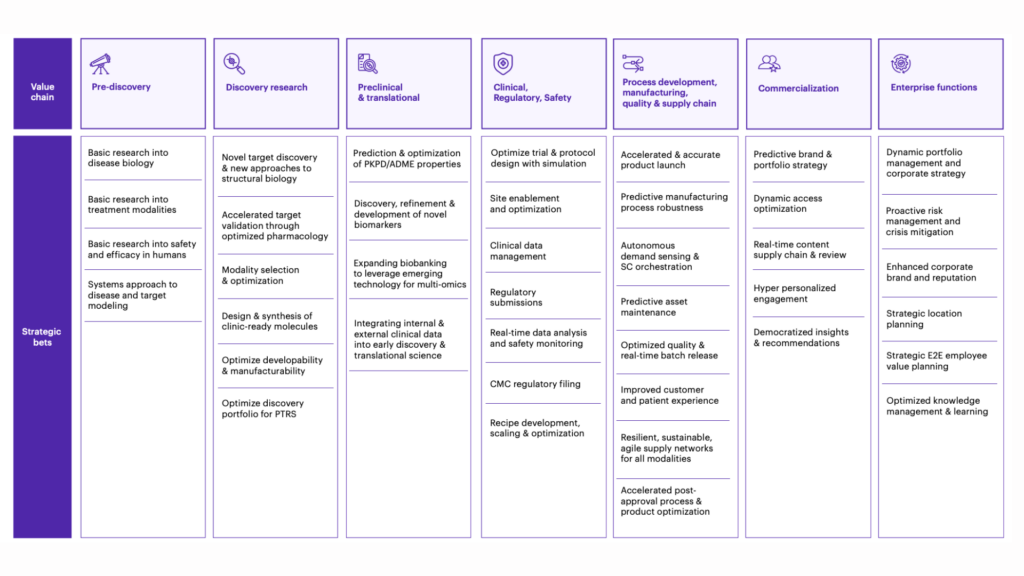
Value Chain Use cases: Pinpointing where the returns Show Up
1. Target identification and validation
AI models trained on multi-omics and clinical data surface novel disease-associated targets and score their druggability and disease relevance before committing wet-lab resources. Mckinsey recent interviews put expected cost reduction here at 67% at peak adoption – the highest of any stage in the pipeline, attributed to how rapidly virtual screening and knowledge-graph-based target discovery are being adopted.
Real example: Insilico Medicine’s PandaOmics platform, applied to idiopathic pulmonary fibrosis, screened candidate targets from omics datasets and NLP-driven literature analysis, narrowing an initial pool down to a single novel intracellular target (TNIK) – a kinase not previously recognized as a fibrosis driver.
2. Analytical lab reporting and QA workflow automation
Automating the translation of raw analytical data: lab results, instrument outputs, unstructured inputs into structured, submission-ready reports, replacing manual compilation that consumes chemist and analyst time and creates delay between a result being generated and it being usable for a decision.
Why it belongs in your value chain even though the example below isn’t a pharma company: every discovery organization runs some version of this problem downstream of the more headline-grabbing generative chemistry work – analytical testing, impurity profiling, stability studies, and CMC documentation all depend on chemists compiling raw instrument data into structured reports, usually against static templates, from fragmented data sources. It’s unglamorous, but it’s exactly the kind of well-bounded, high-friction workflow that’s cheap to automate well and expensive to leave manual.
Dedicatted built a GenAI-powered automated report generation solution for CASSEN Testing Laboratories, an AIHA-accredited chemical testing lab, using Amazon Bedrock, Amazon Textract, and custom LLM models to extract, summarize, and structure raw analytical data into finished reports. The measured results:
- 7x faster report generation – turnaround compressed from days to hours
- 70%+ reduction in manual effort spent on reference verification
- 3x capacity upgrade per run: from roughly 50 markers to 150+ markers processed per run, without adding headcount
- Error rate cut from 10% to 3% – a meaningful accuracy gain alongside the speed improvement
Why this matters for a discovery organization specifically: the same architecture pattern – Textract for structured extraction from lab instrument outputs and scanned documents, Bedrock for summarization and narrative report generation, human chemist review before anything goes out the door applies directly to a pharma QC lab, an analytical testing group supporting CMC filings, or a toxicology reporting function generating structured findings from study data. The capacity gain is worth underscoring for planning purposes: tripling markers-per-run without adding analysts is a direct lever on throughput in exactly the kind of testing bottleneck that otherwise queues behind headcount. It’s also a materially lower-risk, faster-to-deploy entry point than generative molecule design: a 60–90 day engagement rather than a platform build, making it a credible first pilot for an organization still building the case internally for larger AI investment in discovery.
3. De novo hit generation
Generative chemistry engines design novel small-molecule binders conditioned on a target’s 3D structure, rather than screening existing libraries. We estimate 56% cost reduction at peak adoption for hit generation specifically. More importantly for your planning purposes: Insilico reports designing and synthesizing under 80 molecules to reach a preclinical candidate for their TNIK program, compare that to the thousands-to-millions of compounds typically screened in traditional hit discovery.
Generative chemistry module, designed a library of small molecules against the newly discovered TNIK target; the resulting hit, ISM001, showed nanomolar IC50 activity, and after optimization retained potency while gaining solubility and clean ADME properties with the entire hypothesis-to-preclinical-candidate cycle completing in under 18 months at roughly a tenth of typical program cost.
4. Lead optimization
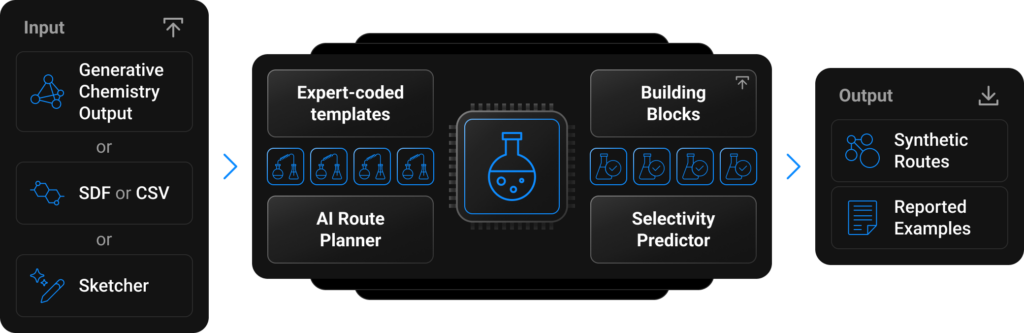
Refining a validated hit’s binding affinity, selectivity, and ADMET profile through fragment addition, scaffold hopping, or reinforcement-learning-guided decoration, while explicitly optimizing for synthesizability. Recent Canadian Department of Health panel estimates 63% cost reduction at peak adoption, citing AI’s ability to “rapidly optimize hit compounds” and refine chemical structures with predicted pharmacological properties simultaneously.
A caution worth relaying to your team: the generative-AI review notes that 3D generative methods frequently output strained, hard-to-synthesize topologies (excess 3- and 4-membered rings, unusual 7-membered rings) unless synthesizability is built into the objective function from the start, where tools that score synthetic accessibility during generation perform meaningfully better on real-world usability than those that don’t.
5. Clinical trial design and patient stratification
AI-generated digital twins: patient-level predictive models trained on historical longitudinal data, forecast how enrolled patients would progress under standard of care, reducing the number of control-arm patients needed and increasing statistical power. Deloitte cites a retrospective analysis across three pivotal Phase III Alzheimer’s trials where digital twins enabled control-arm size reductions of up to 33%, or a 13% boost in statistical power at the same sample size. Tufts Center for the Study of Drug Development found decentralized trial methods, when applied across Phase II and III, add roughly $20 million of value per drug entering Phase II – a sevenfold ROI.
6. Toxicity and ADMET prediction
Predicting a compound’s toxicity, off-target interactions, and pharmacokinetic properties computationally before it reaches expensive in vivo or clinical testing. This is one of the more mature applications: GenAI’s ability to analyze chemical structures for toxicity risk and forecast ADME characteristics as a way to inform “how safe a drug will be for the patient” earlier in the process, before capital is committed to synthesis and animal studies.
7. Manufacturing recipe development and tech transfer
Moving recipe development for complex, biology-based drug products from slow, repetitive wet-lab experimentation into in-silico modeling, and using AI to accelerate knowledge transfer between R&D and commercial manufacturing sites. Accenture cites companies achieving up to a 90% decrease in waste, energy, and water consumption in manufacturing through advanced analytics of complex chemistry and biology recipes, alongside improved consistency and speed.
The infrastructure question: what “AI-ready” actually requires
Biopharma R&D data is chronically fragmented. A typical biopharma company manages over 100 disparate applications spanning general functions and industry-specific needs, with non-standard technology application and persistent data silos between functional areas, creating exactly the kind of handoff friction that limits an AI model’s ability to see the full picture from target discovery through clinical development to manufacturing. Effective R&D data infrastructure needs to unify at least three categories: internal organizational data (early discovery through clinical development), external partnership data, and synthetic data (increasingly central to digital twin generation and filling clinical data gaps).
The switchboard problem: New foundation models are shipping weekly, each with different strengths in cost, latency, accuracy, and domain specificity (general LLMs vs. protein-specific models like AlphaFold or BioGPT). Locking your organization into a single vendor’s model architecture is a real strategic risk given how fast the model landscape is shifting, we personally recommend a flexible “model garden” or switchboard architecture that lets teams select the right model per task (novel biology, molecule design, clinical trial optimization, regulatory submission drafting) rather than a single monolithic solution, while centrally managing cost, performance, and responsible-AI governance.
AI here touches patient safety directly, the risk surface is real and specific: data bias propagating into flawed target selection, confidential IP exposure through model interactions with external data, unreliable outputs in regulatory submission drafting, and , a genuinely underdiscussed point, the compute footprint itself. Generative AI’s energy demand could account for a 5% share of global electricity consumption growth between 2022 and 2027, which is increasingly a governance and ESG consideration for any organization scaling these workloads, not just an ethics checkbox.
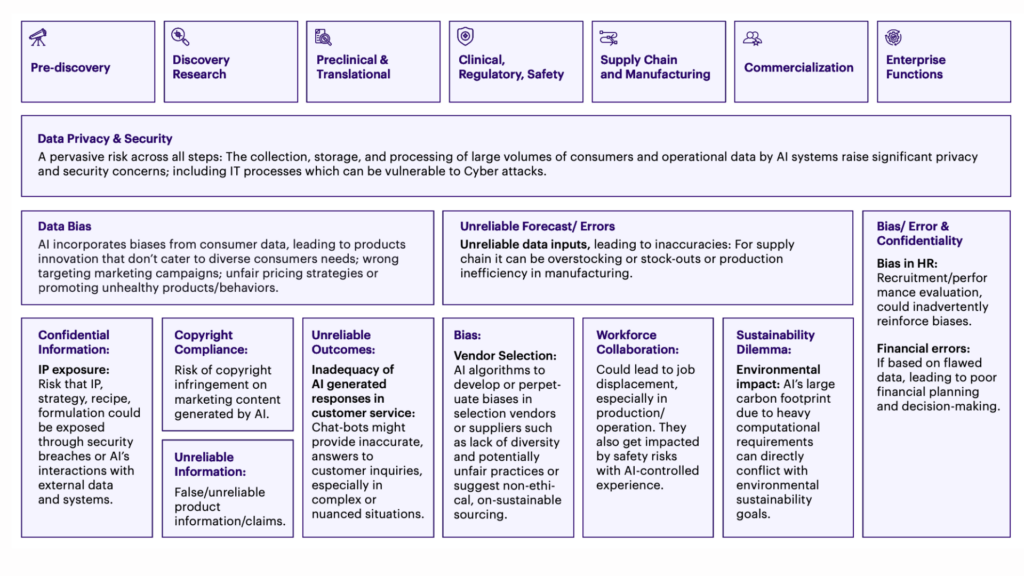
This is where cloud architecture decisions and AI strategy intersect directly. Standing up a modern data platform capable of supporting these workflows: one that breaks down the R&D/manufacturing/commercial silos described above, supports a flexible multi-model architecture, and meets the security and compliance bar pharma regulators expect is a foundational infrastructure investment. This is functionally the same problem organizations across regulated, high-compliance industries face when standing up production-grade generative AI: cloud-agnostic architecture decisions, data governance frameworks that can withstand audit, and MLOps discipline that lets you swap models as the landscape shifts without re-architecting from scratch. It’s also, notably, one of the reasons AWS-funded AI readiness assessments with partners like Us have become a common entry point for pharma organizations evaluating where they actually stand, scoring existing data infrastructure, identifying the highest-leverage use case to pilot first, and mapping a realistic path from proof-of-concept to production before committing to a platform build.
Drug Discovery: AI-Accelerated Molecule Design – AWS Implementation Guide
The first five parts of this piece covered why AI-accelerated molecule design matters and what it costs to ignore it. This section goes one level deeper: what the actual AWS technology stack behind these use cases looks like, what real biopharma organizations have measured after deploying it, and what an implementation roadmap looks like for a discovery organization starting from where most are today – fragmented data, disconnected tools, and a handful of promising pilots that haven’t scaled.
AWS HealthOmics for Drug Discovery: the compute and model orchestration layer
AWS’s purpose-built service for this domain is AWS HealthOmics for Drug Discovery, a HIPAA-eligible platform designed to let research teams run biological foundation models (bioFMs) and bioinformatics workflows without managing the underlying infrastructure themselves. Concretely, it gives your computational scientists direct, managed access to models like AlphaFold and ESMFold for protein structure prediction, and NVIDIA BioNeMo foundation models for molecular design and drug-target interaction prediction – the same category of models discussed in Part 1, but delivered as a managed service rather than something your team has to stand up and maintain.
- Standard workflow languages. Pipelines are built in WDL, Nextflow, or CWL, meaning your bioinformatics team’s existing workflow investments transfer rather than requiring a rewrite.
- Full research provenance. Every prediction is tracked with the exact model version, configuration, and parameters that produced it – a requirement that matters far more in this domain than in typical enterprise AI, because a regulatory submission may need to trace a candidate’s computational lineage years later.
- Elastic HPC that scales to production without a re-architecture. The same environment that runs a scientist’s exploratory molecular dynamics simulation scales to production pipelines processing millions or billions of predictions, closing exactly the “prototype-to-production” gap that stalls most internal AI pilots.
Amazon Bio Discovery: closing the design-to-wet-lab loop
Announced at the 2026 AWS Life Sciences Symposium, Amazon Bio Discovery targets a specific and very real operational bottleneck: the disconnect between computational design and wet-lab validation. Most organizations have the compute and the models; what they lack is the tooling that lets computational biologists and bench scientists work from the same system without manual handoffs.
The application gives researchers no-code access to 40+ AI biology models (plus the ability to bring your own or licensed third-party models), with agentic assistants guiding model selection and configuration. For antibody design specifically: hotspot residue identification, framework selection, multi-property optimization, liability assessment, it walks a scientist from target through a filtered, ranked candidate list, then routes validated candidates directly to integrated CRO partners (Ginkgo Bioworks, Twist Bioscience, A-Alpha Bio) with real-time cost and turnaround estimates. Results flow back automatically into an experimental data registry, closing the active-learning loop that fine-tunes the models on your own newly generated data.
Sanofi’s SWEL – the architecture pattern for enterprise-scale context
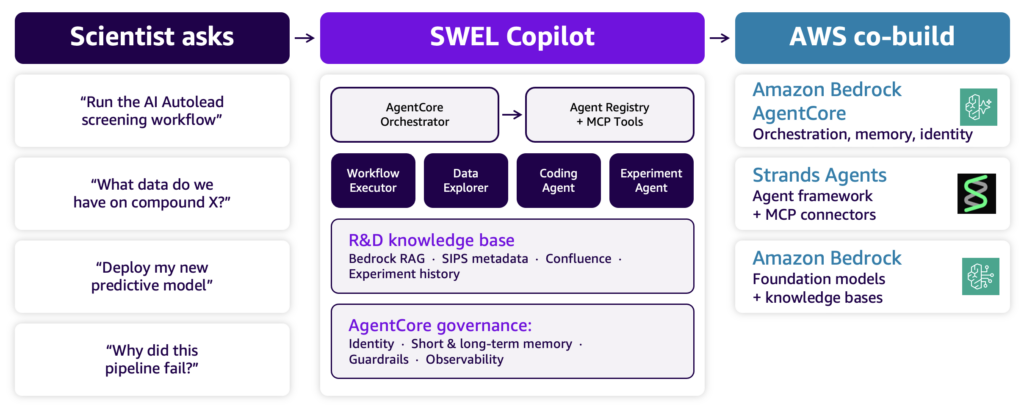
If HealthOmics and Bio Discovery are the “what,” Sanofi’s Scientific Workflow Experience Labs (SWEL) is the most instructive “how” currently publicly documented, because it addresses the exact problem every biopharma organization runs into once they move past isolated AI pilots: models and agents operating without awareness of prior experiments, failed approaches, or parallel work happening elsewhere in the organization.
SWEL’s foundation is SIPS (Scientific Information Processing Services) – a unified data layer built on Amazon S3 using a Lab Data Mesh framework, managing over 20 petabytes of Sanofi’s R&D scientific data with contextual metadata attached at the point of capture (linking instrument outputs to the relevant experiment, sample, protocol, assay, and result).
The lessons Sanofi’s own team draws from this are worth relaying directly to any discovery organization planning a similar path: data readiness is the real starting point – no amount of model sophistication compensates for fragmented, poorly contextualized data. High-impact, operationally critical use cases should come first, not abstract platform-building. Early adopters should be co-builders: Sanofi engaged initial scientist users as active partners shaping the platform. And adoption depends on trust and workflow integration, not model performance alone.
The agentic pattern: what a small team can build fast
The most operationally relevant recent example for a discovery leader evaluating build timelines may be AWS’s own internal experiment building an ADME-Tox prediction agent using Kiro, AWS’s agentic development environment. A team of two developers and one scientist, averaging five hours per week each, roughly 60 combined hours total, built a production-capable agentic system that ingests open-source tools (ADMET_AI, RDKit, ChemProp, DeepChem for ADME prediction; ToxCast/Tox21, QSAR Toolbox for toxicity endpoints; PubMed, ChEMBL, PubChem, DrugBank APIs for literature and bioactivity data) and orchestrates them through Amazon Bedrock AgentCore running Claude Sonnet 4.6.
In testing, the system compared structural analogs and known drug pairs: correctly flagging a known CYP2C9 liability, and independently surfacing a documented nephrotoxicity risk between two sulfonamide antibacterials by reasoning across PubMed literature, with full results returned in under two minutes.
An implementation path for your team from Dedicatted best architects
Pulling the above together, a realistic sequence for a discovery organization moving from scattered pilots to a production capability looks like this:
1. Data foundation assessment. Before selecting any model or platform, map where your R&D data actually lives, how fragmented it is across discovery, translational science, clinical, and manufacturing systems, and what it would take to get it into a unified, well-governed data layer (S3-based data lake/mesh, with Aurora for structured metadata) – the pattern common to every case. This is the single highest-leverage early step, and the one every organization above independently identified as the true prerequisite.
2. One narrowly scoped, high-leverage pilot. Pick a use case with a clear, measurable bottleneck: ADME-Tox triage, a specific target class, a defined virtual screening problem and build against it with a small, focused team our own cases build are both proof that this can be done in weeks with a handful of people.
3. Model orchestration layer. Given how fast the foundation-model landscape moves (weekly new releases, each with different cost/accuracy/latency tradeoffs), build on a switchboard or model-garden pattern: AWS HealthOmics for the bioFM layer , Bedrock AgentCore for agent orchestration and governance, rather than architecting around one model’s current capabilities.
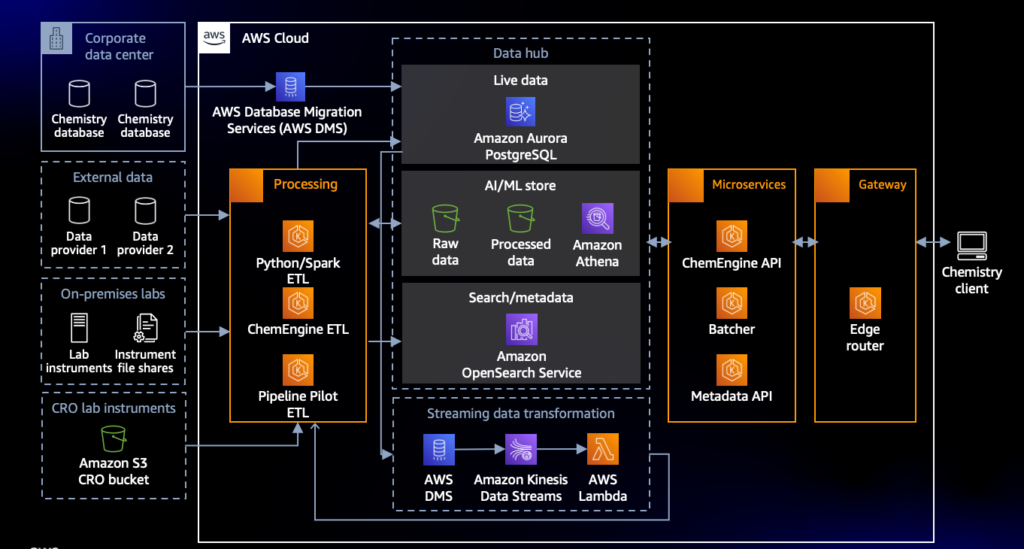
4. Governance built in from day one. Bedrock Guardrails for PII/PHI redaction and hallucination grounding, IAM permission boundaries scoped per agent, full research provenance tracking on every prediction. This isn’t a compliance afterthought layered on later, every production deployment built it in at the architecture stage, specifically because regulatory submission and audit requirements in this industry don’t tolerate retrofitting.
5. Scale via a repeatable pattern, not a bespoke build per site or program. Our “connectivity factory model” – standardizing data access, orchestration, and AI services into reusable building blocks is what let us extend the same core architecture across labs, modalities, and research teams without re-architecting each time.
Want to see where your own setup stands?
If you’re evaluating where to begin : a Well-Architected review of your existing discovery data environment, a scoped generative AI pilot in target identification or lead optimization, a lab-in-the-loop integration connecting computational design to wet-lab validation, or a data platform modernization to unify your R&D, clinical, and manufacturing systems, that’s exactly the kind of conversation our team works through with clients regularly.
Dedicatted is an AWS Premier Tier Services Partner, ranked in the top 2% of AWS partners globally, holding both the Generative AI Competency and Managed Service Provider (MSP) designation. We combine deep AWS cloud and data architecture expertise with hands-on engineering delivery: the actual build, deployment, and ongoing operation of the discovery infrastructure and AI workflows described throughout this piece.
We’d welcome the chance to compare notes on where your discovery organization sits against the use cases, architectures, and benchmarks covered here, and to talk through what a realistic, high-leverage first pilot looks like for your pipeline specifically.


