Read summarized version with
Dedicatted, an AWS Premier Tier Services Partner and Managed Services Provider, has earned the AWS Cloud Operations Services Competency, validated across four solution areas: Cloud Governance, Cloud Financial Management, Compliance and Auditing, Operations Management, and Monitoring and Observability. AWS awards this competency to partners with proven technical expertise and customer success in helping organizations set up, build, migrate, and operate cloud environments securely and efficiently, with an integrated approach rather than one-off fixes. In practical terms: building on AWS is one skill. Running it every day, at scale, without surprises, is another. This competency is AWS confirming, after reviewing our real customer work, that we do the second one well.

What is the AWS Cloud Operations Competency?
The AWS Cloud Operations Competency is part of the AWS Competency Program, which AWS uses to help customers identify partners with deep, validated expertise in a specific area. AWS created the competency because operations is where many organizations struggle most. Without the right operating model, teams have a hard time balancing security, compliance, and operational efficiency with the pressure to innovate quickly. The result is often siloed development, error-prone deployments, and downtime in mission-critical applications. AWS’s view is that organizations focusing on several operational areas together, rather than one at a time, generate a larger return on their cloud investment. That’s why the competency rewards an integrated approach.
AWS groups cloud operations into five solution areas, and partners are validated in one or more of them. Here’s what each one covers, what changes for you, and how you can tell whether it’s working:
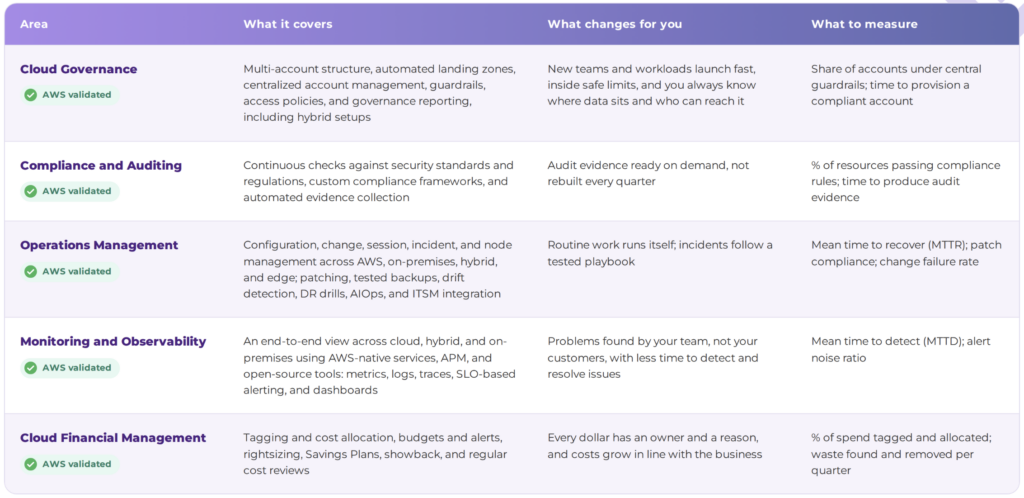
Dedicatted is validated in all five areas: Cloud Governance, Cloud Financial Management, Compliance and Auditing, Operations Management, and Monitoring and Observability. That’s exactly the integrated approach AWS designed this competency to reward. Together, the five areas cover the full operational loop: setting the rules, controlling the cost, proving the rules are followed, running the environment day to day, and seeing everything that happens in it.
What did AWS examine?
An AWS competency isn’t a training badge or a self-declared specialty. To earn it, a partner goes through multiple deep-dive assessments with AWS technical and business teams, often with several rounds of feedback. The review covers three areas:
- People: AWS-certified engineers with hands-on operations experience.
- Process: documented, repeatable, and automated operational practices, from runbooks, escalation paths, and incident response to change control and cost reviews, aligned with the operational excellence pillar of the AWS Well-Architected Framework.
- Proof: detailed customer case studies showing those practices running in real production environments, reviewed for customer success, technical execution, and operational maturity.
The competency also isn’t permanent. Partners have to keep meeting AWS’s requirements and renew it to stay listed. AWS reviewed how we actually run environments, not how we describe them on slides.
What the competency opens up for clients?
Beyond validation, the competency changes what’s available when you work with us:
- A listing you can verify. Competency partners appear in the AWS Partner Solutions Finder, so you can confirm the designation yourself.
- Closer collaboration with AWS. Competency partners take part in co-selling and joint programs with AWS, which means AWS specialists can be brought into your engagement when it helps.
- Access to AWS funding programs. Depending on the project and its goals, qualifying workloads may be eligible for AWS funding that offsets part of the cost of assessments, migrations, or modernization. The amount varies by project.
- Faster, safer onboarding for growing companies. Startups and scale-ups get a proven operating model from day one instead of building one through trial and error.
- Assurance for enterprises. Larger organizations get a partner whose frameworks and processes AWS has already reviewed, which shortens procurement and vendor risk checks.
What does it mean for a client?
Working with a Cloud Operations Competency partner means your environment is run by a team whose methods AWS has already checked. In practice:
- Fewer surprises in production. Monitoring and alerting are built around what matters to your business, so problems are caught early, often before your team ever notices.
- Faster, calmer incident response. Documented runbooks, automated remediation where it’s safe, and root-cause reviews, so the same issue doesn’t happen twice.
- Governance that scales with you. Multi-account guardrails and policies mean new teams and workloads can move fast without creating security gaps.
- Audit-ready by default. Continuous compliance checks and organized evidence, instead of a scramble before every review.
- Cloud spend you can explain. Cost visibility, regular reviews, and optimization, so your bill reflects what you actually use and need.
- Less risk in choosing a partner. You skip much of the vetting, because AWS has already reviewed how we operate.
Anyone can deploy a stack. The real question is who you trust to keep it running at 3 a.m. Our customers have trusted us with exactly that for years, and now AWS has reviewed and validated how we do it. This competency is a strong signal to every organization that wants its cloud to be secure, reliable, and cost-efficient long after go-live.
How does Dedicatted deliver it?
Whether we’re taking over an existing environment or setting up a new one, our cloud operations work follows five stages:
Assess. We review your current environment against AWS best practices and the Well-Architected Framework, and identify gaps in governance, monitoring, security, cost, and reliability.
Build the foundation. We set up or fix your multi-account structure, landing zone, guardrails, and access policies, all defined as code so they’re reviewable and repeatable.
Make it visible. We put monitoring, logging, and alerting in place around what matters to your business, with dashboards your engineering and leadership teams can both use.
Automate and operate. We automate patching, backups, configuration, and routine fixes, and run the environment with documented runbooks and incident response.
Optimize continuously. Regular cost, security, and performance reviews keep the environment improving, not just running.
Five questions to ask any cloud operations partner
Whether you work with us or not, these questions quickly separate a partner who runs environments from one who only builds them:
- Has anyone independent checked your operations? An AWS Cloud Operations Competency means AWS has reviewed the practice behind the answers above.
- What happens at night, when something breaks? Ask for the escalation path, response times, and who actually picks up.
- How do you measure success? Look for MTTD, MTTR, availability against SLOs, and cost trends, reported regularly, not just “tickets closed.”
- Is your setup defined as code? Guardrails, monitoring, and infrastructure should be versioned and reviewable.
- How do you handle cost? A good partner shows you where money goes, finds waste, and reviews it with you on a schedule.
Who is Cloud Operations Services Competency for?
This competency is most relevant if your cloud is growing faster than your ability to run it:
- Scaling companies whose AWS environment grew quickly and now needs structure, visibility, and guardrails.
- Enterprises with multi-account estates that need consistent governance and compliance across many teams.
- Regulated organizations in financial services, healthcare, and the public sector that need continuous compliance and audit readiness.
- Teams running AI and data-heavy workloads where reliability and cost control decide whether a project survives in production.
- Companies without a 24/7 in-house operations team that want an AWS-validated partner to run their environment.
Signs your cloud needs stronger operations
You don’t need a crisis to benefit from better operations. If two or more of these sound familiar, it’s worth a conversation:
- Your customers sometimes notice problems before your team does.
- Your AWS bill grew faster than your business last quarter, and nobody can fully explain why.
- You have more AWS accounts than people who understand how they’re set up.
- Audit preparation means weeks of screenshots and spreadsheets.
- Incidents get solved by whoever happens to be online, and the same issues come back.
- AI or data workloads went live, and costs or reliability became harder to predict.
- You don’t have a 24/7 operations team, but your business runs 24/7.
The hardest part of operations is consistency: doing the right thing every time, across every customer, not just when it’s easy. Going through the AWS review pushed us to document and prove processes we run every day, and it made our practice even stronger. For our MSP customers, this means more predictable operations and fewer surprises.
Ready to talk about your sovereignty requirements?
Whether you need a one-time operations assessment, help fixing governance and cost, or a partner to run your AWS environment day to day, we’ll help you see where you stand and what to fix first.Book a call with our team
Our AWS credentials at a glance
AWS Competencies
- Migration & Modernization Consulting
- DevOps Consulting
- Data & Analytics Consulting
- AI Services
- Resilience Services
- Financial Services Consulting
- Retail Consulting
- Consumer Goods Services
- Cloud Operations Services Competency
- Digital Sovereignty Services Competency
- Healthcare Consulting Competency
Partner programs
- Premier Tier Services
- AWS Managed Service Provider (MSP)
- Authorized Commercial Reseller
- AWS Well-Architected Partner Program
Taken together, this portfolio is what enables Dedicatted to operate as a single, accountable partner across the full engagement lifecycle: from initial architecture and migration through managed operations, security, and sustained AI adoption, with no handoffs between vendors along the way. Ready to put a Premier-tier team on your next AWS project? Contact us


