Read summarized version with
About project
Working time:
2025 – 2026
Industry:
Airlines & Travel
The service:
Internal POC Factory & AI-DLC Enablement
Overview
Our client builds the digital systems that airlines run their operations on: booking, crew scheduling, disruption management, and day-of-operations tooling. The estate is integration-heavy by nature, spanning around 60 engineers across Canada and the United States, with every system wired into airline-specific data sources and regulatory constraints.
That complexity was also the client’s biggest bottleneck. Every new idea needed its own environment, its own architecture research, and its own path through DevOps before anyone could tell if it was worth building. Validating a single idea took about a month, most of it spent on setup rather than engineering. Dedicatted built an internal POC factory: a self-service environment platform paired with an AI-DLC delivery pipeline, so a team can move from a stated intent to a working, standards-compliant prototype inside their own AWS account in days. Because the platform is grounded in the client’s actual architecture and data contracts, viable prototypes don’t get discarded. They become the first commit of the production feature.
The Challenge
Environment provisioning was a bottleneck by itself. Every POC needed its own compute, storage, and data before any code got written. Provisioning ran through DevOps tickets, took days, and typically produced a sandbox that didn’t match production topology closely enough to validate anything meaningful.
Architectural context lived outside the build process. Reference architectures, approved data sources, and platform standards were split across Confluence spaces, service repos, and institutional knowledge held by a handful of senior engineers. Builders had to manually reconstruct this context for every prototype, and gaps in that reconstruction meant POCs regularly diverged from how the company’s systems were actually built.
POCs carried no forward value. Because prototypes were built in throwaway sandboxes without the client’s standards or hooks enforced, a POC proving product value still had to be rebuilt from scratch to ship. Validation and delivery were two separate projects instead of one continuous path.
Every stage depended on a different team. DevOps for environments, platform architects for design guidance, data teams for source access. None of these dependencies were unreasonable on their own, but stacked together they made experimentation slow enough that fewer ideas got tested at all.
Want to get your copy of the case study?
By submitting this form, you agree with our Terms & Conditions and Privacy Policy.
Technology & Approach
Step 1: Build a governed context layer
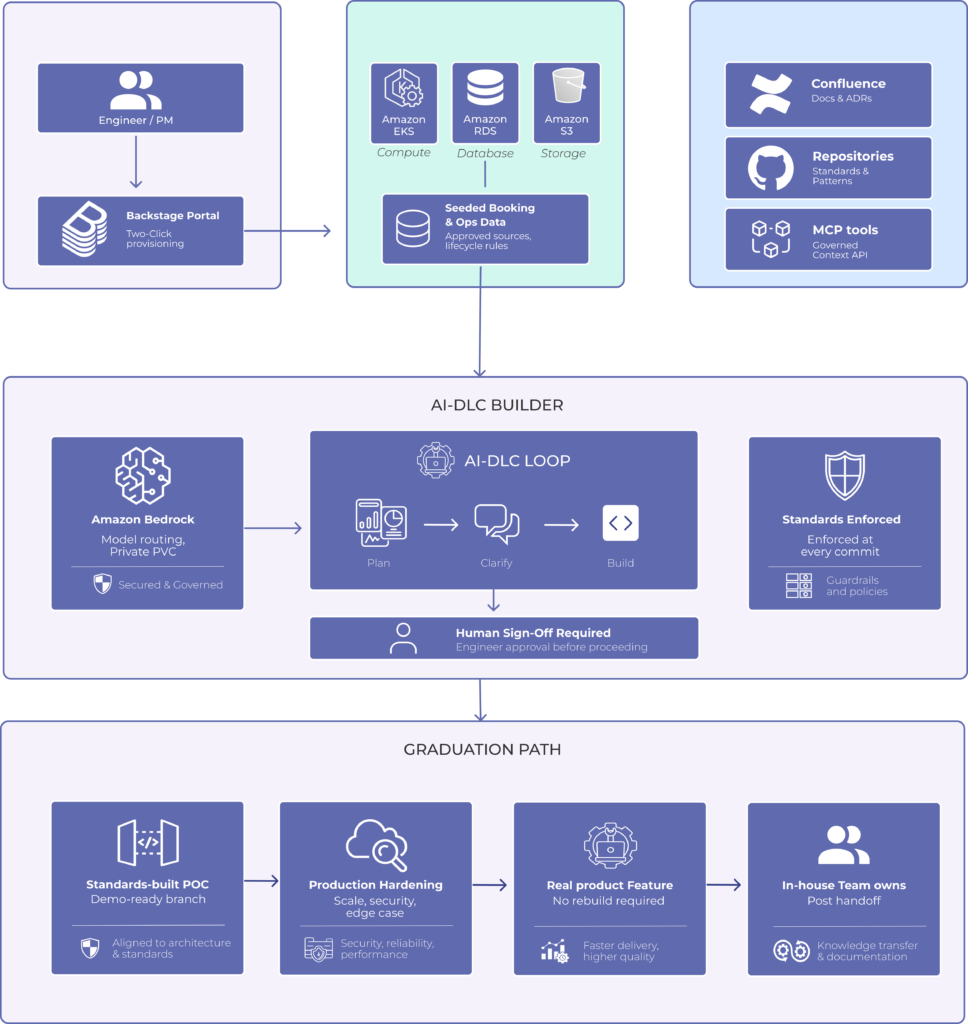
Dedicatted extracted the client’s architectural rules, reference patterns, and approved data sources from Confluence and service repositories into a structured context layer, and exposed it to the AI builder through MCP (Model Context Protocol) tool integrations. This gave the AI-DLC pipeline direct, machine-readable access to the client’s actual standards instead of general-purpose assumptions.
Step 2: Provision production-parity environments on demand
A Backstage developer portal serves as the entry point. Golden-path templates provision EKS for compute, RDS for relational data, and S3 for storage, each shaped to mirror the client’s production topology rather than a simplified sandbox. Environments are seeded with representative data drawn from the client’s approved sources, and lifecycle policies automatically decommission environments once a team’s work is done, keeping infrastructure spend contained.
Step 3: Ground the AI-DLC builder in the client’s own standards
With an environment live, an AI-DLC builder running on Amazon Bedrock takes an engineer’s stated intent (for example, prototyping a disruption-rebooking flow), plans an implementation, surfaces clarifying questions, and proceeds to build only after explicit human sign-off. Model routing runs behind a governed endpoint inside the client’s own AWS account, so no prototype logic or data leaves their environment boundary. Custom hooks and validation rules enforce the client’s architectural standards throughout the build, rather than checking for compliance after the fact.
Step 4: Engineer a direct path from POC to production
Because every prototype is built against the client’s real architecture inside a production-shaped environment, a POC that clears validation carries its codebase forward into the actual product rather than serving as a disposable reference implementation. Validation and delivery collapse into a single pipeline.
Step 5: Transfer AI-DLC as a way of working, not just a tool
The platform itself was built using the AI-DLC methodology it now offers to other teams: plan, clarify, build, human sign-off. Dedicatted ran enablement as hands-on mob-programming sessions against live backlog items, so engineering teams learned the workflow by shipping real prototypes with it rather than sitting through a training deck.
Business impact
- Idea validation compressed from roughly a month to days. The gate between “we have an idea” and “we have a working prototype” moved from a multi-week environment-and-context-gathering exercise to a same-week build cycle.
- Environment provisioning collapsed from a multi-day DevOps queue to a two-click self-service action. Engineers no longer wait on ticket queues to get a production-representative place to build.
- POCs stopped being throwaway work. Because every prototype is built to production architecture and standards from its first commit, validated ideas move directly into the delivery pipeline instead of requiring a second, separate build effort.
- Cross-team dependency dropped across the validation phase. Environment provisioning, architectural guidance, and data access are now served by the platform itself, reducing the DevOps, architecture, and data-team involvement previously required for every single POC.
- Platform ownership transferred in-house. An internal platform team now owns the Backstage templates, the context layer, and the governance rules, so the factory continues to improve and extend after Dedicatted’s direct engagement ends.


