Agentic AI Solutions & Consulting
Agentic AI
Autonomy you can hold accountable
Agentic AI consulting is a service that helps businesses implement autonomous AI agents that automate workflows, make decisions, and execute complex tasks using real-time data and large language models, delivered by Dedicatted, an AWS Premier Tier Partner specializing in enterprise AI, cloud, and DevOps solutions.

Understanding agentic AI
What is agentic AI?
Agentic AI refers to intelligent systems that can autonomously make decisions, take actions, and complete tasks based on goals, context, and real-time data.
What are agentic AI services?
Agentic AI services include solution design, AI agent development, workflow automation, system integration, and deployment of autonomous AI systems for business use cases.
What does an agentic AI company do?
An agentic AI company builds and deploys autonomous AI agents that can perform tasks such as data analysis, customer interaction, process automation, and decision support.
Why agentic AI programmes stall
Gartner expects over 40% of agentic AI projects to be cancelled by the end of 2027, and names three causes. The rest of this page answers them.
-
Escalating cost
Agents that run unbounded burn tokens, compute, and engineering time with no unit economics anyone signed off on.
-
Unclear business value
The use case was never scored against a number the business wanted to move, so nobody can say whether it worked.
-
Inadequate risk controls
No one can answer what the agent may do alone, who is accountable when it acts wrong, and how its actions are audited.
Source: Gartner press release, June 2025, agentic AI project cancellation forecast.
our process
Dedicatted provides Agentic AI consulting services that help businesses build autonomous AI agents for workflow automation and decision-making using large language models, real-time data, and enterprise AI infrastructure.

1. Explore
Identify high-impact agentic AI use cases aligned with your business goals, data readiness, and existing systems.
- Identify high-impact, feasible use cases aligned with business priorities
- Assess data availability, workflows, and system readiness for AI integration
- Define agent roles, integration points, and compliance or security requirements

2. Implement
Build, integrate, and deploy autonomous AI agents into your cloud and DevOps stack with full observability.
- Build and fine-tune agents using domain-specific data and feedback loops
- Establish observability, perform rigorous testing, and validate with stakeholders
- Seamlessly deploy and integrate within your existing technology stack

3. Maintain
Monitor, optimize, and scale your AI agents with continuous governance, compliance, and performance tuning.
- Track agent behavior, refine logic, and update training data
- Optimize systems for cost-efficiency, speed, and output quality
- Maintain governance, security, and compliance across all AI operations
Our agentic AI solution
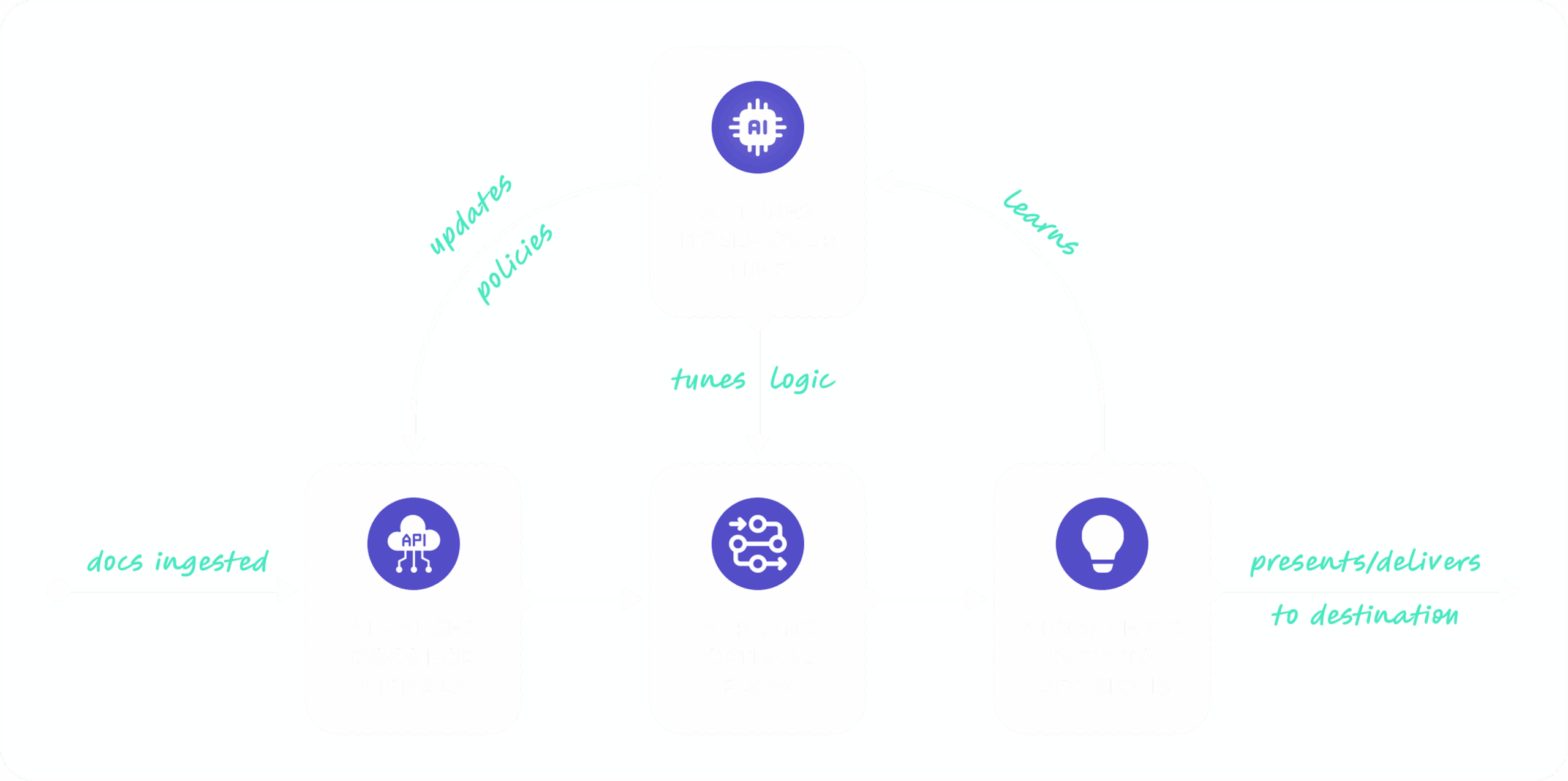
One continuous loop: every decision the agent delivers feeds back into how it parses and plans the next one.
Bounded autonomy and accountability
Autonomous does not mean unaccountable. Every agent we ship has three answers written down before it touches production.
What the agent does alone
- A distinct digital identity per agent — scoped credentials, not shared service accounts
- Narrow, modular design — one job per agent, composed rather than monolithic
- Authority capped — anything above a pre-set limit routes to a human
What a person signs off
- A named owner, validator, and steward for every agent in production
- Explicit kill switches — any agent can be stopped instantly, by role, not by ticket
- Escalation paths agreed before launch, not invented during an incident
How it stays auditable
- Every action logged with the reasoning behind it — replayable end to end
- Integration with your existing model-risk review, not a parallel process
- Runs in your perimeter — your data stays in your account, you own the code
- 50+ AI use cases shipped to production
- Month → days proof-of-concept time on an aviation platform, once agents took over provisioning and validation
- 100% of the intellectual property assigned to the client
Benefits for your business

Increased Efficiency
Agentic AI systems can manage hundreds of user interactions simultaneously with minimal human intervention

Data-driven decisions
AI agents uncover actionable insights from interactions, driving smarter, faster, and fully compliant decisions.

Scalability
AI agents can adjust their processing capacity to match demand, tackle complex tasks, and automate workflows

Enhanced customer satisfaction
By analyzing data from various touchpoints and past interactions, AI-powered agents can predict customer needs and offer proactive solutions.

Around-the-clock service availability
This enables businesses to eliminate wait times and service gaps often occurring during off-peak hours or high-demand periods.

Ready to See Agentic AI in Action?
Experience how Agentic AI made by Dedicatted can think, plan, and act across complex tasks – without constant prompting.
How is agentic AI implemented?
How do companies implement agentic AI?
Companies implement agentic AI by identifying use cases, preparing data, selecting models, designing agent workflows, and integrating AI agents into existing systems.
What is the agentic AI implementation process?
The process includes discovery, use case definition, data preparation, model selection, agent development, system integration, deployment, and continuous optimization.
How long does it take to implement agentic AI?
Implementation typically takes 4–12 weeks depending on system complexity, data availability, and integration requirements.
What are the benefits of agentic AI?
Why use agentic AI services?
Agentic AI services help automate complex workflows, reduce manual effort, improve decision-making speed, and enable scalable autonomous operations.
What are the key benefits of agentic AI?
Key benefits include autonomous task execution, real-time decision-making, improved operational efficiency, scalability, and enhanced user experiences.
How does agentic AI improve business performance?
Agentic AI improves performance by streamlining processes, reducing errors, enabling continuous operations, and accelerating time-to-value.
Industry Expertise
Healthcare
Healthcare
Clinical and administrative work still moves at the speed of a person reading a document. Agentic AI monitors device and record data for anomalies, drafts prior authorisations and discharge summaries, and routes anything clinical to a named human before it counts — so the agent does the reading and your team does the deciding.

Manufacturing
Manufacturing
Agents watch equipment telemetry continuously, predict maintenance before a line stops, and adjust operating parameters inside limits you set. Anything outside those limits routes to a human rather than executing — which is what makes autonomy on a production line something a plant manager will sign off.

Financial
Financial
Multi-agent workflows review alerts, analyse transaction patterns and draft findings, with authority capped so an agent recommends and executes within a pre-set limit and everything above it goes to a person. Every action is logged with the reasoning behind it, and the review plugs into your existing model-risk process.

Retail
Retail
Agents monitor stock in real time, read demand from sales patterns and adjust orders without waiting for a weekly review. In the supply chain they track shipments, predict delays and reschedule around them — continuously, rather than when someone happens to look.

Insurance
Insurance
Agents process claims, detect fraud through real-time pattern analysis and personalise policy recommendations, while continuously monitoring risk indicators. Underwriting decisions above a threshold route to an underwriter, and every one carries the reasoning that produced it.

Supply Chain
Supply Chain
Agents coordinate across suppliers, carriers and warehouses at once: tracking shipments, predicting disruption and re-planning routes as conditions change. The work that used to wait for a planner to notice now happens continuously, inside the constraints you define.

Healthcare
Clinical and administrative work still moves at the speed of a person reading a document. Agentic AI monitors device and record data for anomalies, drafts prior authorisations and discharge summaries, and routes anything clinical to a named human before it counts — so the agent does the reading and your team does the deciding.
Manufacturing
Agents watch equipment telemetry continuously, predict maintenance before a line stops, and adjust operating parameters inside limits you set. Anything outside those limits routes to a human rather than executing — which is what makes autonomy on a production line something a plant manager will sign off.
Financial
Multi-agent workflows review alerts, analyse transaction patterns and draft findings, with authority capped so an agent recommends and executes within a pre-set limit and everything above it goes to a person. Every action is logged with the reasoning behind it, and the review plugs into your existing model-risk process.
Retail
Agents monitor stock in real time, read demand from sales patterns and adjust orders without waiting for a weekly review. In the supply chain they track shipments, predict delays and reschedule around them — continuously, rather than when someone happens to look.
Insurance
Agents process claims, detect fraud through real-time pattern analysis and personalise policy recommendations, while continuously monitoring risk indicators. Underwriting decisions above a threshold route to an underwriter, and every one carries the reasoning that produced it.
Supply Chain
Agents coordinate across suppliers, carriers and warehouses at once: tracking shipments, predicting disruption and re-planning routes as conditions change. The work that used to wait for a planner to notice now happens continuously, inside the constraints you define.
Insights


FAQ
What is an AI agent?
An AI agent is a system that perceives its environment, processes information, and takes actions to achieve specific goals without constant human input.
What technologies are used in agentic AI?
Agentic AI uses technologies such as large language models, machine learning, APIs, vector databases, and orchestration frameworks for autonomous workflows.
Is agentic AI suitable for all businesses?
Agentic AI can be applied across industries, but its effectiveness depends on clearly defined processes and availability of structured or semi-structured data.
What is the difference between agentic AI and traditional AI?
Traditional AI focuses on predictions or outputs, while agentic AI systems can take actions, make decisions, and execute multi-step workflows autonomously.
How is agentic AI integrated into existing systems?
Agentic AI is integrated through APIs, cloud platforms, and workflow orchestration tools that connect AI agents with business systems and data sources.
Who owns the code and the data?
It runs inside your own perimeter, so your data stays in your account and you own the resulting code. Intellectual property from the engagement is assigned to you.
What happens when an agent gets something wrong?
Every agent in production has a named owner, validator and steward, an explicit kill switch that any of them can pull by role rather than by ticket, and an authority cap — anything above a pre-set limit routes to a human before it executes.
How do you keep agent activity auditable?
Each agent has its own digital identity rather than a shared service account, and every action is logged with the reasoning behind it so a decision can be replayed end to end. The review plugs into your existing model-risk process instead of running alongside it.
Agentic AI Solutions and Consulting Services
Agentic AI is an AI architecture that enables autonomous agents to plan, reason, make decisions, and execute multi-step tasks using large language models, tools, APIs, and real-time data. Dedicatted provides enterprise Agentic AI solutions for enterprise automation, Agentic AI integration services, DevOps operations, and intelligent workflow orchestration.
Dedicatted delivers agentic ai solutions that help businesses automate operations, optimize workflows, and improve decision-making using autonomous AI agents integrated with cloud and DevOps environments. Our consulting services focus on practical enterprise use cases, secure deployments, and scalable AI operations rather than experimental prototypes.
We design and implement agentic ai platforms that integrate with CI/CD pipelines, observability systems, cloud infrastructure, ticketing platforms, and internal enterprise tools. These systems help organizations reduce manual operations, improve deployment reliability, and accelerate operational workflows.
Agentic AI Platforms
Choosing the right agentic ai platforms is critical for secure and scalable AI adoption. As an Agentic AI development company, Dedicatted evaluates platforms based on integration capabilities, security controls, scalability, observability, and compatibility with enterprise DevOps environments.
Our team helps businesses:
- evaluate agentic ai platforms
- design AI deployment strategies
- implement governance and security controls
- integrate AI agents with enterprise systems
- optimize infrastructure for AI operations
- create rollout and migration plans
We focus on building enterprise-ready AI environments that balance operational efficiency, security, scalability, and measurable business value.
What are Agentic AI Tools?
Agentic ai tools are AI-powered systems that can plan actions, use external tools, process data, and execute workflows autonomously. Dedicatted implements agentic ai tools that integrate with cloud platforms, observability stacks, deployment pipelines, and enterprise applications.
Dedicatted implements agentic ai tools for:
- infrastructure automation
- incident response workflows
- deployment validation
- cloud cost optimization
- observability and monitoring analysis
- engineering productivity automation
- compliance-friendly documentation
Agentic AI Architecture
A scalable agentic ai architecture combines large language models, planning logic, memory layers, tool integrations, and operational safeguards. Through our Agentic AI implementation services, Dedicatted designs agentic ai architecture patterns that fit secure enterprise environments and modern cloud operations.
Our architectures include:
- large language models and reasoning engines
- memory and context management
- CI/CD and cloud integrations
- policy enforcement and approval workflows
- monitoring and auditability
- secure enterprise API integrations
Agentic AI works by combining reasoning, planning, and tool use to complete tasks autonomously. Agents perceive context, decide next actions, call tools or APIs, evaluate outcomes, and iterate until goals are achieved.
Common agentic ai use cases include:
- automated incident triage
- infrastructure drift correction
- deployment validation
- DevOps workflow automation
- cloud operations management
- internal knowledge retrieval
- compliance and documentation workflows
- healthcare and financial process automation
AWS Agentic AI Cloud Services
AWS agentic AI cloud services provide the foundation for secure, scalable, and production-grade agentic AI deployments. Dedicatted designs AWS-native agentic AI architectures that integrate with existing cloud environments and DevOps pipelines.
We deliver:
- AI infrastructure deployment
- AI agent orchestration
- cloud-native AI integrations
- DevOps automation for AI operations
- observability and monitoring platforms
- multi-agent coordination systems
- enterprise workflow integrations
Get started with an Agentic AI consultant
Briefly outline your challenge — our team responds within one business day with relevant experience and initial technical insights.
Thanks, we have it.
Our team replies within one business day, with relevant experience and a first read on your problem.