Read summarized version with
U.S. shoppers spent $9.86 billion online during Amazon’s Prime Big Deal Days on October 6–7, up 8.5% year over year. That landed just under latest $9.9 billion forecast, and it happened while the Conference Board was reporting consumer confidence near a 12-year low. Marketing teams read those numbers as a revenue story. A managed services team reads them as a load profile. Spread evenly across 48 hours, $9.86 billion is roughly $3.4 million in U.S. online sales every minute, industry-wide. It was not spread evenly, and that unevenness is where infrastructure wins or loses.
This article looks at the October event the way our MSP team looks at any peak: what the traffic actually did, which AWS layers it stressed, how Amazon itself prepares, and what retail teams should change in the 46 days left before Black Friday on November 27. Platform modernization is a multi-quarter program; peak readiness is what you can still fix.
Prime Big Deal Days 2026: the 48 hours as a load profile
The event was front-loaded, fragmented into many small orders, and spiky by category. Each of those traits stresses a different part of the stack, and none of them shows up in a revenue headline. Between day one and day two, Amazon ad impressions fell 16.4%, clicks 14.9% and platform-reported purchases 24.4%, while median ROAS slid from 3.34 to 2.90. The peak was the first hours, not the second day. Capacity that arrives reactively, after autoscaling notices the surge, arrives after the most valuable traffic has already been served or lost.
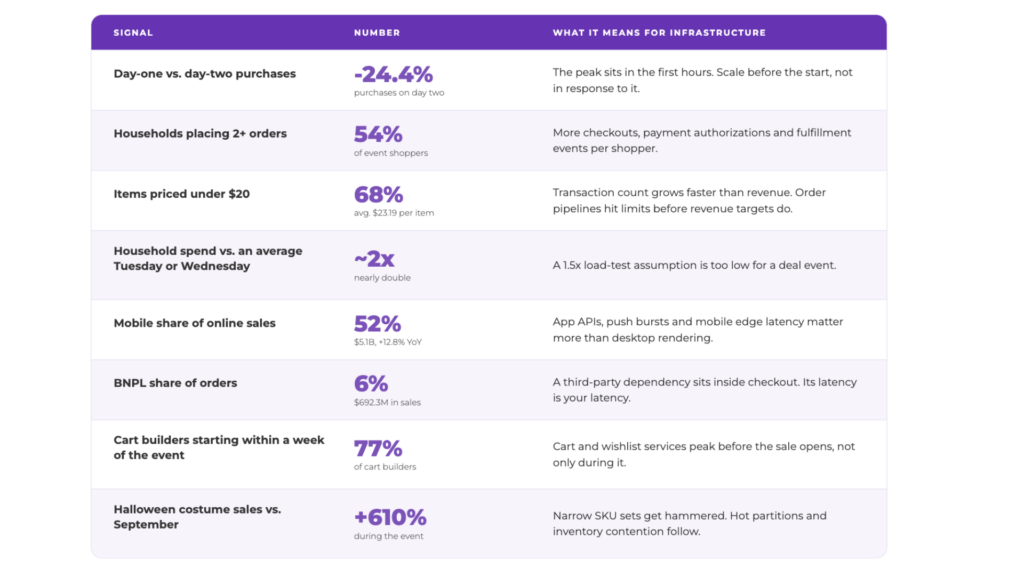
The last row deserves a second look. Headphones and speakers rose 300% and smartwatches 255% against September. Demand concentrated on a small number of products is the classic trigger for hot keys in DynamoDB, lock contention on inventory rows in Aurora, and cache stampedes when a single popular product page expires at the wrong moment.
Five Prime Big Deal Days load patterns and what each one breaks on AWS
1. The opening surge: autoscaling is too slow by design
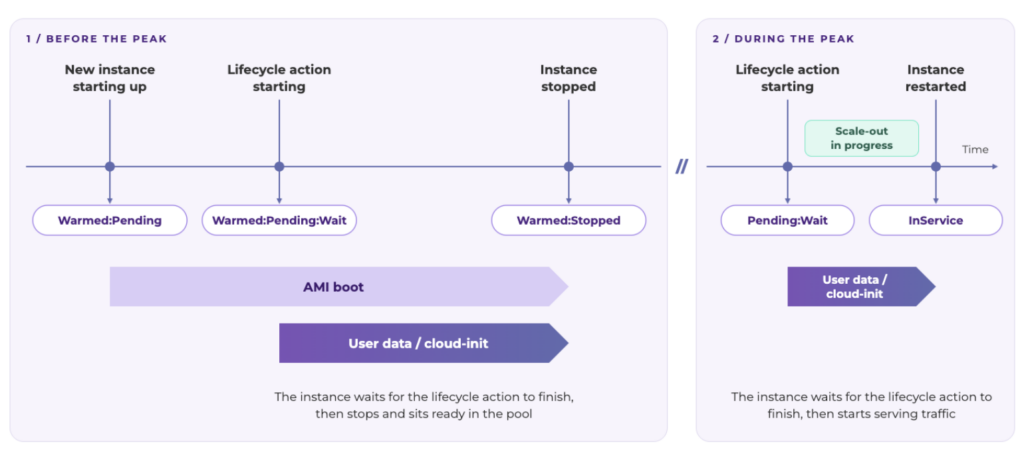
Target-tracking autoscaling reacts to a metric that has already moved. A new EC2 instance typically needs a few minutes to launch, boot and pass health checks, and in a front-loaded event those minutes are the peak. The fix is to be scaled before the doors open, and to check every quota that sits between you and that capacity.
- EC2 and ECS: scheduled scaling actions that raise minimum capacity an hour before start, plus predictive scaling where traffic history exists. Warm pools keep pre-initialized instances ready for the next step up. For instance types you cannot run without, On-Demand Capacity Reservations remove the risk of an insufficient-capacity error in one Availability Zone at the worst possible moment.
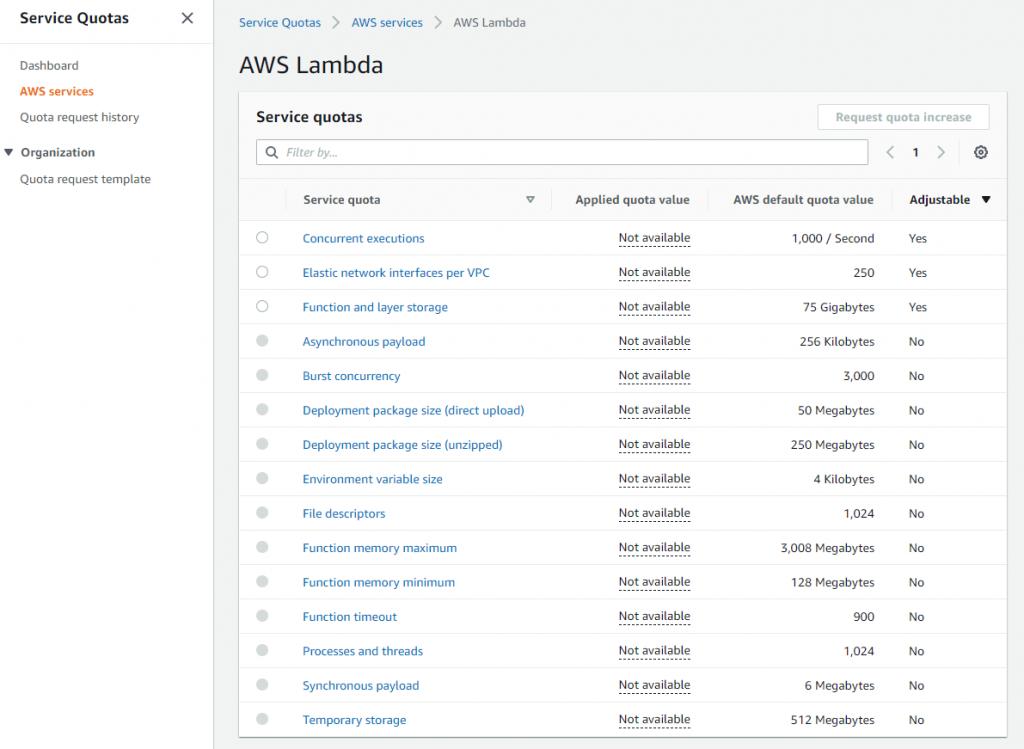
- Lambda: each function scales by up to 1,000 concurrent executions every 10 seconds, but the regional account concurrency quota still caps the total. Teams regularly discover that a default quota is shared by checkout, image resizing and a forgotten batch job. Raise it through Service Quotas weeks ahead, reserve concurrency for checkout-critical functions, and use provisioned concurrency where cold starts would show up in P99.
- DynamoDB: on-demand tables scale automatically, but they scale from their previous peak. Warm throughput lets you pre-warm a table or index to the read and write rate you expect, so day one does not become a throttling event.
- Load balancers: Application Load Balancers scale with traffic, and capacity unit reservation lets you set a floor ahead of a known spike instead of relying on the balancer to catch up.
2. The price flip: a mass write at the moment of peak read
Impact Analytics tracked average discount depth across 1,000 products jumping from 13% in the pre-period to 30% once the event opened. For a retailer running the same playbook, that means thousands of price and promotion changes taking effect at the exact minute traffic peaks. This is where we see some of the most expensive peak incidents: cache invalidation storms, search indexes re-indexing under load, and shoppers briefly seeing yesterday’s price at checkout.
Price exposure matters more every year. AWS found that 32% of shoppers using AI tools during the event used them to check price history, and the 25% discount threshold is where a deal starts reaching half of shoppers. A wrong price is now visible, screenshotted and compared within minutes.
- Load event prices days ahead as effective-dated records, and switch by timestamp or a feature flag in AWS AppConfig rather than a bulk update job at midnight.
- Version cache keys (for example, a price-book version in the key) instead of relying on CloudFront invalidations at T-0. Warm the new keys before the flip.
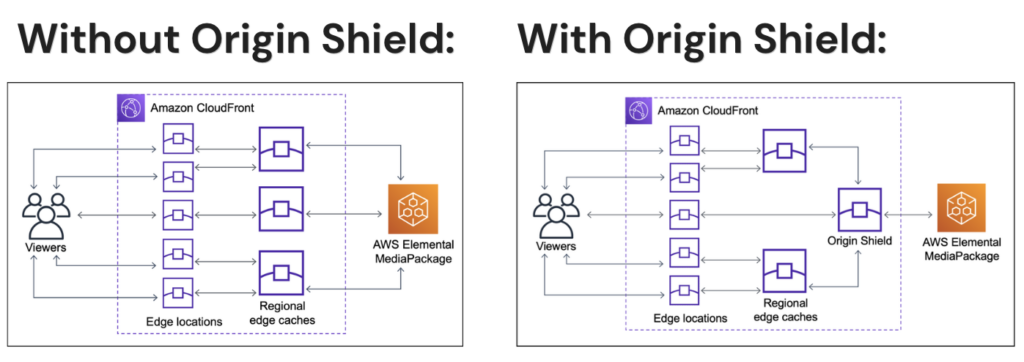
- Put CloudFront Origin Shield in front of pricing and catalog origins so a cache miss storm collapses into one request per object, not thousands.
- Rehearse the flip in staging with production-scale data. A promotion engine that takes 40 minutes to recalculate a catalog is a finding you want in October, not on November 27.
3. Many small orders: transaction count outruns revenue
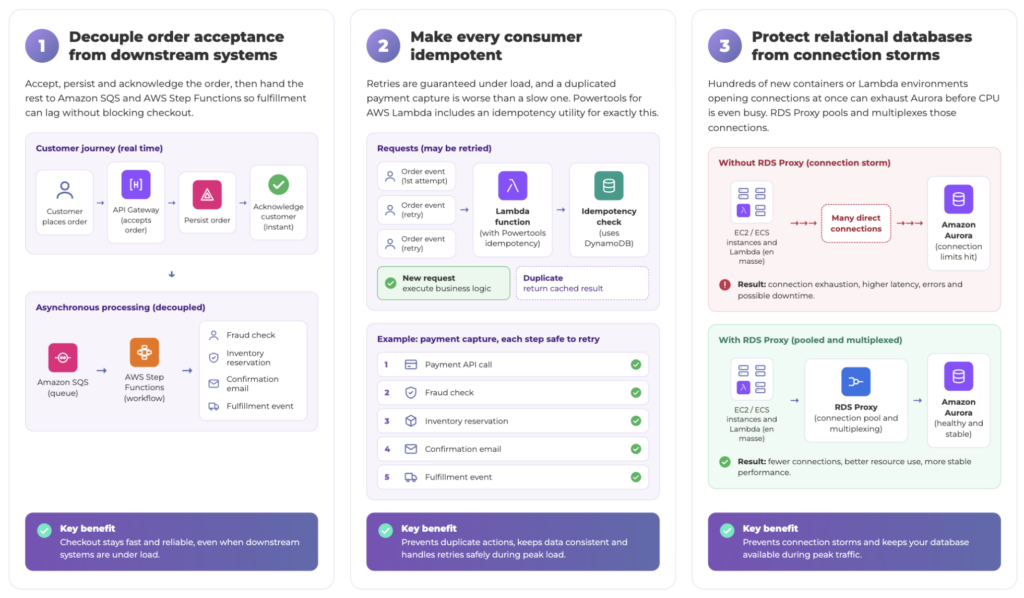
With 68% of items under $20 and over half of households placing multiple orders, an order pipeline hits its limits long before revenue looks unusual. Each order is a payment authorization, a fraud check, an inventory reservation, a confirmation email and a fulfillment event.
- Decouple order acceptance from everything downstream. Accept, persist and acknowledge the order, then hand the rest to Amazon SQS and AWS Step Functions so fulfillment can lag without blocking checkout.
- Make every consumer idempotent. Retries are guaranteed under load, and a duplicated payment capture is worse than a slow one. Powertools for AWS Lambda includes an idempotency utility for exactly this.
- Protect relational databases from connection storms. Hundreds of new containers or Lambda environments opening connections at once can exhaust Aurora before CPU is even busy. RDS Proxy pools and multiplexes those connections.
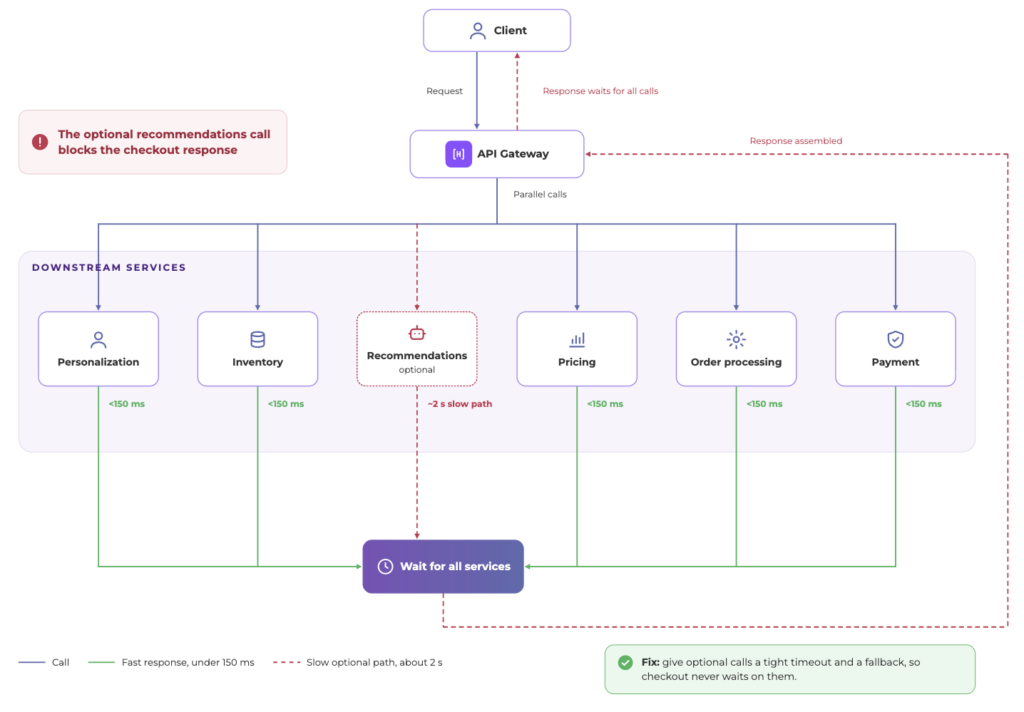
4. Third parties inside checkout: their outage becomes yours
BNPL handled 6% of orders. Add tax calculation, fraud sWith 68% of items under $20 and over half of households placing multiple orders, an order pipeline hits its limits long before revenue looks unusual. Each order is a payment authorization, a fraud check, an inventory reservation, a confirmation email and a fulfillment event.coring, address validation and payment gateways, and a typical checkout depends on four to six external APIs. None of them is covered by your autoscaling.
- Set explicit timeouts and circuit breakers on every external call. A BNPL provider responding in 8 seconds should hide the BNPL option, not freeze the checkout page.
- Run Amazon CloudWatch Synthetics canaries through the full checkout path, third parties included, every minute during the event. You want to know a payment provider is degrading before your conversion rate tells you.
- Agree on degradation rules with the business in advance: which features can be switched off, by whom, and with what approval.
5. Hot SKUs and self-inflicted spikes
A single DynamoDB partition supports up to 3,000 read units and 1,000 write units per second. An inventory counter for a viral product is a single item, and every purchase writes to it. Sharded counters, inventory reservation pools, or a short-lived ElastiCache layer for reads keep one SKU from throttling the table.
The other spike retailers create themselves is the push notification. With 52% of sales on mobile, a “deals are live” push to two million app users produces a synchronized wave of app opens within seconds. Send in batches over 10 to 15 minutes, or pre-scale the app API to absorb the full burst.
How Amazon prepares for Prime events on AWS, and what retailers can borrow for Black Friday
AWS published its infrastructure numbers, and the most instructive figure is not the traffic. It is the 44,000 AWS Fault Injection Service experiments Amazon ran beforehand, more than six times the 2025 number
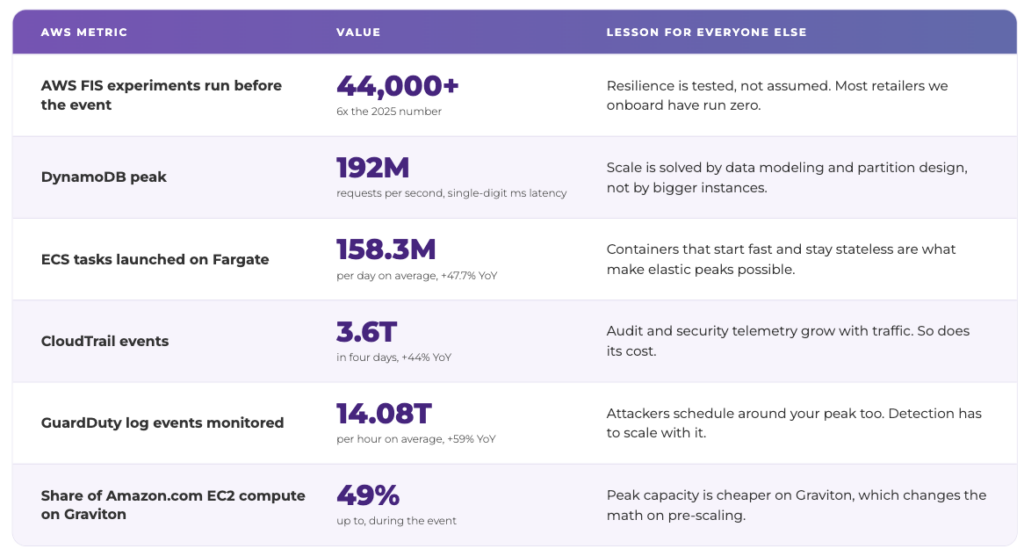
Three things translate directly to a retailer running a fraction of that scale:
Start chaos engineering small and specific. You do not need 44,000 experiments. You need five that match your real failure modes: an Availability Zone becoming unavailable, 2 seconds of injected latency on the payment provider, a primary Aurora failover during load, a throttled DynamoDB table, and a failed deployment rolled back mid-traffic. AWS FIS has pre-built scenarios for several of these. Running them in staging two weeks before an event finds the runbook gaps while there is still time to fix them.
Budget for observability at peak, not at baseline. CloudWatch Logs ingestion, CloudTrail data events and GuardDuty analysis are priced on volume. A retailer whose traffic triples for 48 hours will see those line items triple too. We have seen teams lower log levels in panic mid-event to control cost, which removes visibility exactly when it is needed. Set sampling and retention policies in advance instead.
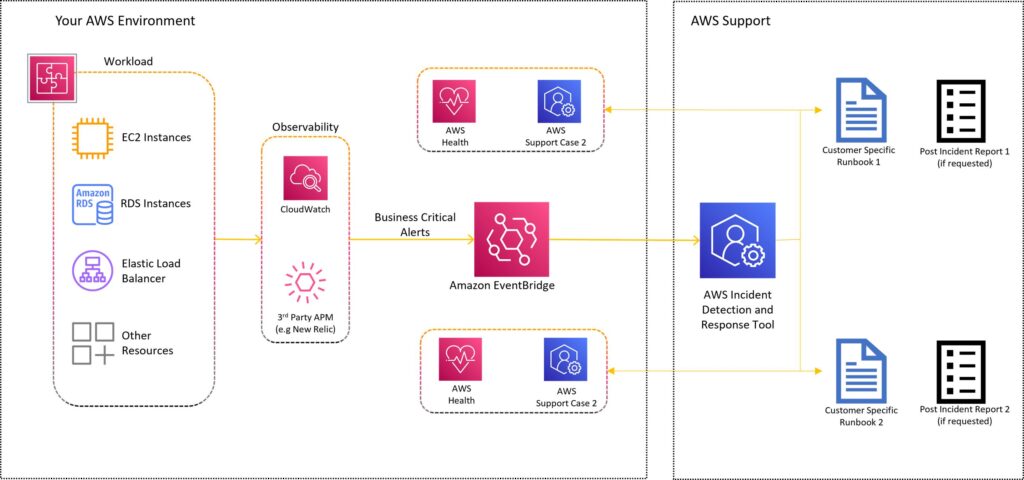
Use the programs that exist. AWS Countdown, including its Premium tier, provides structured readiness reviews, capacity planning and designated engineers for planned events. For Enterprise Support customers, AWS Incident Detection and Response adds 24/7 incident management. An AWS partner can request and coordinate these on your behalf, and should be the one translating their findings into changes in your environment.
AI shopping traffic on Prime Big Deal Days: a new peak tier on AWS
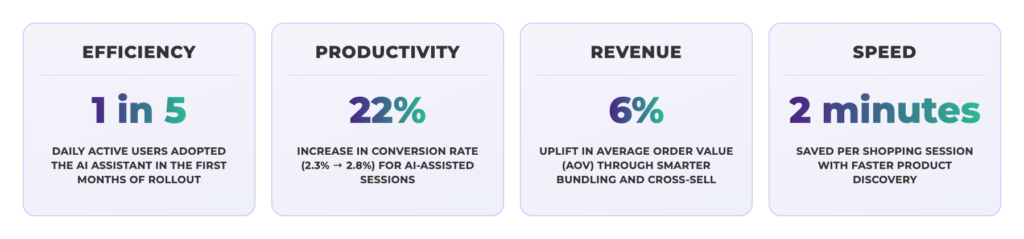
AI-driven traffic is the load pattern most retail infrastructure was not designed for, and it converts better than the traffic it was designed for. Adobe expected AI referrals to U.S. retail sites to grow 48% year over year for the October event. In June, AI traffic during Prime Day rose 89% and converted 40% better than non-AI channels, a reversal from the previous year, when it converted 23% worse. Amazon told advertisers at unBoxed 2026 that 65% of shoppers now use AI to research products.
For infrastructure, this shows up in two separate ways that need separate answers.
Inbound: agents and assistants hitting your site
When a shopper asks an assistant to compare prices, the assistant (or the agent acting for it) fetches product pages, availability and prices, often in parallel, without cookies, and without the browsing rhythm your caching was tuned for. Recent Adobe survey found price comparison was the top AI use case at 45%. That is high-frequency, read-heavy, cache-unfriendly traffic.
The instinct to block it is usually wrong, because this is the traffic converting 40% better. The better approach is to classify and shape it:
- AWS WAF Bot Control separates verified bots from unverified automation, and rate-based rules can cap the unverified tail without touching shoppers.
- Serve machine-readable product data (structured data on pages, product feeds) from the CDN cache, so an agent’s 50 requests cost you 50 cache hits rather than 50 origin calls.
- Make the policy a business decision, documented before the event: which agents get full access, which get rate-limited, which get a challenge. Changing it during an incident is how good traffic gets blocked.
This is the same “machine customers” shift our retail modernization whitepaper describes: agents interact through APIs and data, not interfaces. Retailers whose catalog, price and inventory data cannot be served cleanly and consistently to machines become invisible in that channel.
Outbound: your own assistant under peak load
If you run a conversational shopping assistant, inference is now a capacity tier with its own limits. On Amazon Bedrock, model throughput is governed by per-model, per-Region quotas on requests and tokens per minute. Those quotas, not your containers, are usually the first thing to throttle when traffic doubles.
Amazon’s own assistant shows the scale of the problem. For Prime Day 2024, Rufus ran on more than 80,000 Inferentia and Trainium chips across three AWS Regions, kept P99 time to first response under one second, and could rebalance traffic between Regions in under 15 minutes. A mid-market retailer does not need that footprint, but it needs the same design ideas:
- Cross-Region inference on Bedrock to spread load across Regions automatically, and Provisioned Throughput where you need guaranteed capacity during a defined window.
- Caching at two levels: prompt caching for the long, stable system prompt and catalog context, and a semantic cache for the questions every shopper asks on deal day (“is this the lowest price”, “does it ship by Friday”).
- A fallback chain: a smaller, faster model when the primary throttles, and classic search when inference is unavailable. The assistant should degrade, never take the product page down with it.
- Grounding that holds under load: answers checked against live price and stock before they are shown. A confidently wrong price from an assistant on deal day is a support ticket and a trust problem at once.
Dedicatted applied these ideas when building a Rufus-style generative AI shopping assistant for an e-commerce marketplace , whose shoppers switch between Arabic and English mid-session. Keyword search could not interpret situational queries like “what do I need for a beach day?”, so the assistant was designed as a semantic problem rather than a localization task.
The architecture shows where peak capacity actually lives in an AI assistant:
- Models: Amazon Bedrock (Claude, Nova and Titan models) for intent understanding and recommendations. Bedrock quotas were sized in the first, infrastructure-setup phase, before any prompt was written.
- Orchestration: custom MCP servers coordinate specialized tools: structured search against marketplace APIs, semantic and hybrid search on Amazon OpenSearch Service, curated web lookup, and co-bought and trending analytics. Third-party connectors are isolated, so one slow dependency cannot stall the conversation.
- Grounding: every recommendation follows a deterministic path: intent inferred, products retrieved via RAG, validated, enriched with co-bought signals, and returned with its reasoning. The assistant cannot invent a product.
- Operations: containerized MCP servers on auto-scaling AWS infrastructure, logged tool-call chains, and tuned rate limits that balance latency against inference cost.
What Black Friday readiness on AWS looks like when it works
The difference between a peak incident and a peak non-event is usually measured in minutes, and those minutes are set by process long before the traffic arrives. More than 90% of the incidents Dedicatted’s MSP team handles are caught by automated monitoring before any customer is affected. One night from our incident history shows what that means in practice.
| 03:25 | Unusual traffic surge begins on a client’s e-commerce platform |
| 03:56 | Load crosses the alert threshold; on-call engineer is paged automatically |
| 04:03 | Client notified of the situation |
| 04:04 | Root cause identified: the spike traced to a specific traffic origin |
| 04:08 | WAF challenge rule live; load returns to normal |
| Morning | Client wakes up to a resolved incident report, zero downtime |
Nothing in that timeline depended on it being a sale day. That is the point. The same alert thresholds, escalation ladder and runbooks run at 3 AM on an ordinary Tuesday and at the opening minute of a Prime event.
Another client, an e-commerce business that is regularly targeted by DDoS traffic, runs on a Grafana, Prometheus, Loki and HAProxy observability stack with a three-step escalation ladder: chat first, then SMS and push, then a phone call. Every runbook follows the same four parts: trigger, validation, steps to resolution, and escalation criteria. In one recorded incident, response took 1.5 minutes and resolution 3 minutes, under five minutes end to end with no downtime.
Two more results from the retail side of our MSP practice:
- A ten-hour outage on the first day of an engagement lasted longer than that same customer’s total downtime over the entire following year, once the bottleneck was fixed and monitoring and runbooks were in place.
- A fast-growing e-commerce company with no 24/7 coverage and fragmented ownership moved to 24/7 L2/L3 support, formal Major Incident Management, recurring Well-Architected Reviews and disaster recovery simulations. The result was its first-ever Black Friday with zero service interruptions, and availability rising to 99.97%.
We monitor infrastructure 24/7. We do not wait until the customer escalates an issue to us. The issue gets escalated automatically
After Prime Big Deal Days: the work that comes before Black Friday
The two weeks after a peak decide whether the next one goes better, and they carry their own operational spike. Four things belong on the post-event list.
- Returns and service claims arrive in a second wave. A sales surge produces a returns and warranty-claims surge a few weeks later, right as teams start preparing for Black Friday. Dedicatted built a generative AI pipeline for retail clients that automates claim intake end to end: Amazon Textract extracts structured data from whatever the customer submits, Amazon Comprehend classifies claim type and urgency, and Amazon Bedrock checks each claim against policy and coverage rules, with low-confidence cases routed to human review. Automating intake removes pressure from support teams at the moment they can least afford it.
- Peak capacity left running is pure cost. Raised Auto Scaling minimums, On-Demand Capacity Reservations (billed whether used or not), Provisioned Throughput on Bedrock, and debug-level logging all keep charging after the traffic is gone. Put the scale-down in the same runbook as the scale-up, with an owner and a date.
- Seasonal access outlives its purpose. Every peak brings temporary staff, contractors and partner integrations. The single most common gap our team finds when onboarding a new retail client is not a missing firewall rule. It is access left over from an event that ended months earlier. Time-bound permission sets in IAM Identity Center and the unused-access findings in IAM Access Analyzer turn that cleanup from an annual audit into a routine.
- Join infrastructure data to business data. We advise brands to compare their own day-one and day-two results before setting Black Friday pacing. Do the same with infrastructure: plot P99 checkout latency, error rate and third-party response times hour by hour against conversion rate. If conversion dipped in the hour your payment provider slowed down, that is a number the CFO will understand. Run a blameless Correction of Errors review on anything that went wrong, and turn each finding into an owned action before November.
The 46-day AWS countdown to Black Friday
As of October 12 there are 46 days until Black Friday on November 27 and 49 until Cyber Monday on November 30. That is enough time to fix most of what October revealed, if the work starts this week. Here is the sequence we would run.
October 12–19: inventory what you depend on
Check for Amazon Pinpoint. AWS ends support for Pinpoint on October 30, 2026. After that date, Pinpoint segments, campaigns, journeys and analytics are no longer accessible. SMS, push and voice APIs continue under AWS End User Messaging, email moves to Amazon SES, and engagement workflows move to Amazon Connect. If your Black Friday push or abandoned-cart journeys still run on Pinpoint, they stop four weeks before the biggest weekend of the year.
List every Service Quota on the critical path: Lambda concurrency, EC2 vCPU limits per instance family, API Gateway throttling, Bedrock tokens per minute, DynamoDB table limits. RequeAs of October 12 there are 46 days until Black Friday on November 27 and 49 until Cyber Monday on November 30. That is enough time to fix most of what October revealed, if the work starts this week. Here is the sequence we would run.st increases now. Some take days to approve.
Map every third-party API inside checkout and its timeout, retry and fallback behavior and pull your own October data: peak requests per second, P99 latency by hour, top error codes, and which SKUs ran hot.
October 20 – November 6: test like it’s November. Load test at a minimum of 2x last year’s Black Friday peak, with the burst shape of a deal-event opening, not a gentle ramp. Run an AWS FIS game day: AZ unavailability, payment-provider latency, Aurora failover under load. Rehearse the price flip with production-scale promotion data, and time it. Test the push-notification burst against the app API.
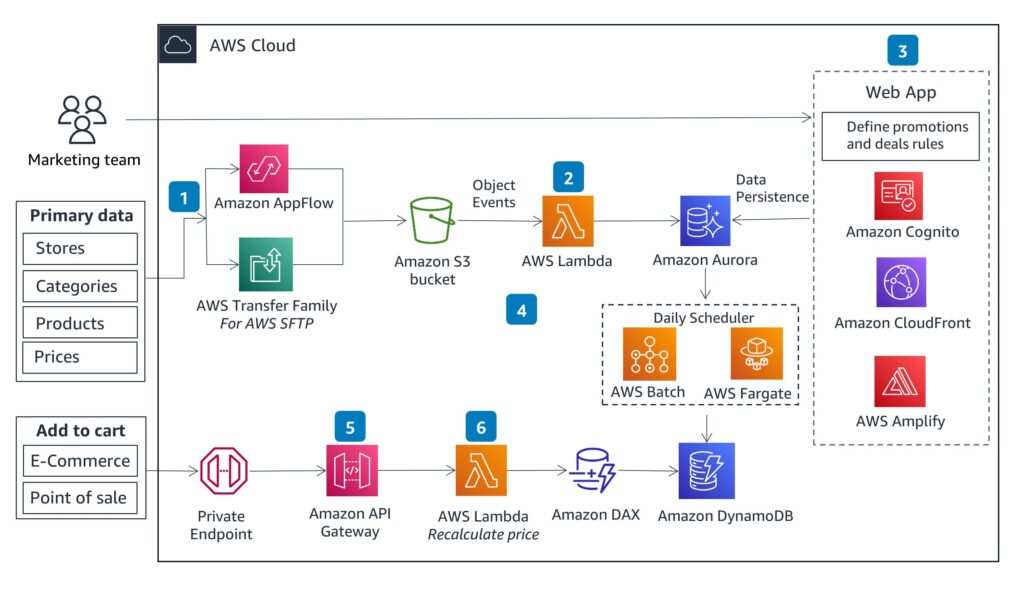
November 9–20: lock the policies. Finalize AWS WAF rules, Bot Control settings and the AI-agent traffic policy. Sign off degradation rules with the business: what gets switched off, in what order, by whom. Set observability sampling, retention and budget alerts for peak volume. Confirm the on-call roster, escalation ladder and P1 response commitments in writing.
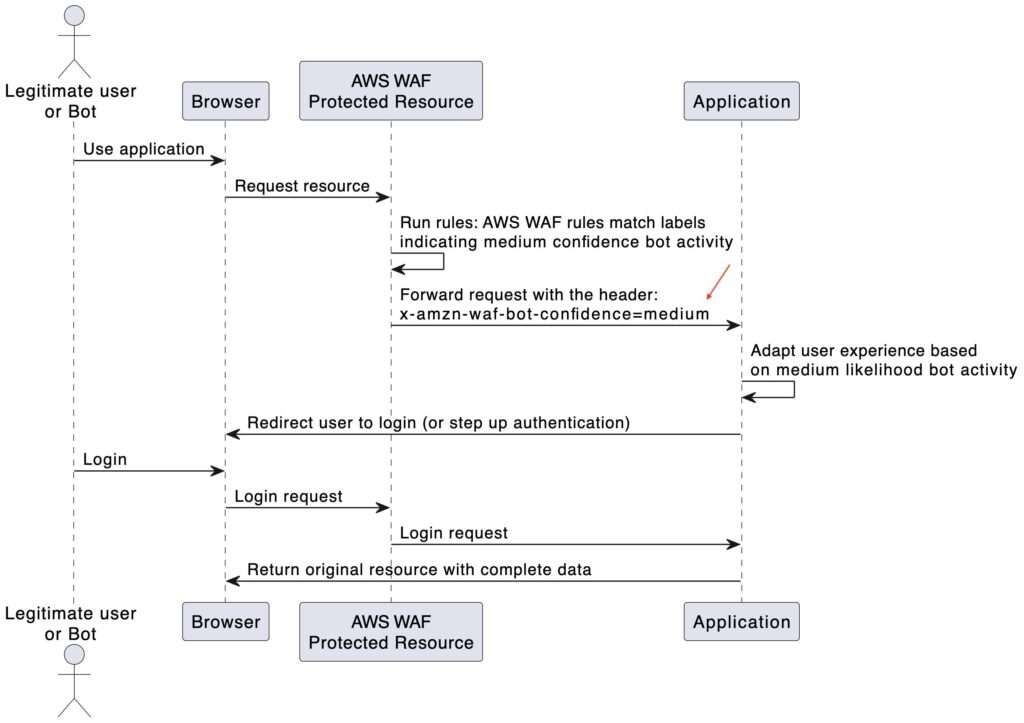
November 23–26: freeze and pre-scale. Change freeze on the checkout path, with an explicit exception process. Raise Auto Scaling minimums, activate capacity reservations, pre-warm DynamoDB tables and set load balancer capacity floors. Pre-load effective-dated prices and warm caches for the new price keys.
November 27 – 30: run the war room. Synthetic canaries through full checkout every minute; dashboards that show conversion next to latency. One named incident owner per shift, with authority to trigger degradation rules.
December 1–14: close the loop. Scale down and cancel temporary reservations. Expire seasonal access. Run Correction of Errors reviews. Prepare for the returns and claims wave.
When Prime Big Deal Days exposes the platform: AWS modernization before the next peak
Some peak problems cannot be fixed with quotas and pre-scaling. If a promotion takes days to ship because the core system is 20 years old, or every load-test environment needs a DevOps ticket, the countdown above will only get you through November. Those fixes take quarters, and January is the right time to start them. Two Dedicatted retail engagements show what that work looks like.
Modernizing a 300-store core without one day of disruption
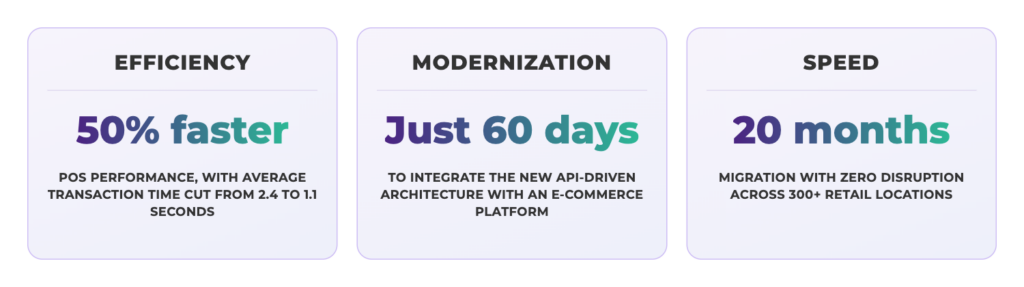
A major Canadian retailer with over 300 locations ran supply chain, inventory, POS and finance on IBM i (AS/400): 4.5 million lines of RPG IV, 300,000 lines of CL, 2,000 terminal screens and 1,800 DB2/400 tables. Release cycles ran 3 to 6 months, RPG talent was scarce, and the platform could not expose APIs to an e-commerce front end, so peak promotions had to be planned a quarter ahead with no way to react inside a season. Dedicatted ran the migration to AWS as a factory-scale program. A four-month discovery with CAST Imaging and custom static analysis mapped dependencies across six business domains and found 18% dead code, about 810,000 lines removed before migration, saving roughly three months of effort.
A custom pipeline then converted RPG IV to Java (Spring Boot) with 82% automation, keeping manual remediation for precision-critical parts like the inventory pricing engine. All 2,000 terminal screens became Angular web applications that preserved existing workflows for more than 20,000 employees, and Qlik Replicate CDC kept DB2/400 and the new PostgreSQL database in sync, so both systems ran in parallel until each regional wave was validated. All 300+ stores stayed fully operational through the entire 20-month migration. Average POS transaction time dropped from 2.4 to 1.1 seconds, which matters most on exactly the days when checkout lines are longest, and the new API layer let the retailer launch a modern e-commerce platform within 60 days of go-live.
Removing the DevOps queue before the next peak
Peak preparation is mostly engineering work: load tests, game days, price-flip rehearsals, hotfixes. At a large retailer Dedicatted worked with, all of it waited in the same queue, because developers depended on DevOps for routine environment and deployment tasks and documentation was scattered. Dedicatted built a self-service Internal Developer Platform on AWS: a Backstage portal, a catalog of golden-path blueprints for Lambda and Amazon EKS services, VPC, RDS and S3 infrastructure, and Glue and Athena data workflows, plus an embedded AI assistant connected to internal documentation, Jira and Confluence.
Two parts of it matter directly for peak readiness. Dynamic environments are created and torn down automatically with lifecycle rules and can be linked to a Jira task, so a team can spin up a production-like environment for a load test or an FIS game day and know it will not survive as forgotten spend in December. Golden paths mean a hotfix during a change freeze follows the same tested pipeline as every other deployment, instead of a manual exception. The organization saw a 40% drop in DevOps tickets for environment access and a 2–3x increase in deployment frequency per team. More capacity to ship changes in October is what makes a calmer November possible
From Prime Big Deal Days to Black Friday: peak is a discipline, not a date
Prime Big Deal Days showed the shape of the holiday season before it starts: a front-loaded opening, more small orders, sharper price changes, and a growing share of traffic arriving through AI assistants that compare before they buy. None of those patterns will be gentler on November 27. AWS’s own guidance for retailers says it plainly: peak readiness is a daily discipline, not a one-time event.
Dedicatted is an AWS Premier Tier Services Partner with the AWS MSP designation, the Generative AI Competency, and SOC 2 and ISO 27001 certification. Our MSP team runs 24/7 monitoring and automated escalation for retail platforms across the whole peak calendar, from Prime events to back-to-school to the viral moment nobody scheduled. If you want an outside view of your environment before Black Friday, start with a Well-Architected review focused on the five patterns above, or estimate what managed coverage would cost with the calculator at msp.dedicatted.com.
Book a short call with us and we will walk through your October numbers and what they mean for November.


